10 Best Office Chairs For Lower Back Pain in 2026
This post contains affiliate links. As an Amazon Associate, we earn from qualifying purchases.
For lower back pain, the Marsail Ergonomic Office Chair offers the best balance of thick cushioning and adjustable support. The CASASIO Ergonomic Office Chair is our pick for all-day comfort, while the CAPOT Ergonomic Mesh Office Chair provides the most precise micro-adjust lumbar control.
The real challenge with lower back pain is finding a chair that supports your spine’s natural curve without creating pressure points. Many chairs offer lumbar support, but few allow you to dial in the exact depth and height your back needs.
This guide is based on manufacturer specifications, expert round-ups, and patterns in owner feedback. We focused on adjustable lumbar support, seat cushion quality, build materials, and warranty coverage to help you choose with confidence.
Top 10 Office Chairs For Lower Back Pain in the Market
Certain content that appears on this site comes from Amazon. This content is provided "as is" and is subject to change or removal at any time.
The Best Office Chairs For Lower Back Pain, Reviewed
Marsail Ergonomic Office Chair

What We Like
- 3.14" thick high-density foam seat cushion
- Adjustable lumbar support (1.18" forward/backward, 2.16" up/down)
Trade-offs
- At 30.4 pounds, not the lightest to move
- Weighs 30.4 pounds, heavier than some alternatives
The trade-off is weight: at 30.4 pounds, it’s not the easiest to slide across a carpet or lift onto a desk riser, though it’s still manageable for most home offices. Compared to the lighter CASASIO Ergonomic Office Chair at 30 pounds, the Marsail offers a thicker seat cushion and more lumbar adjustment points, which can make a real difference for chronic lower back pain. If you prioritize a plush, adjustable seat and targeted lumbar support over a featherlight frame, this chair delivers where it counts.
Product photos
CASASIO Ergonomic Office Chair
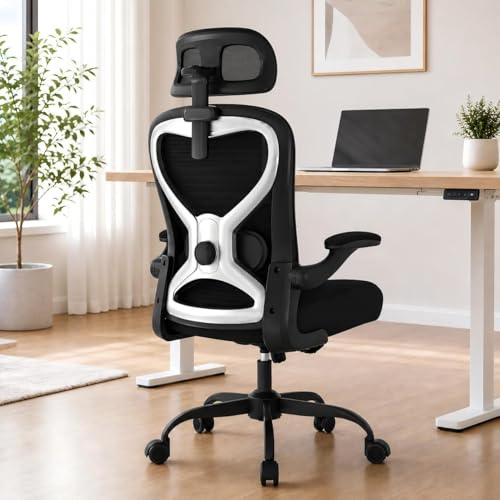
What We Like
- 4-way adjustable lumbar cushion
- 3.5" virgin foam seat for all-day comfort
- 3D adjustable headrest for neck support
- Tilt and rock function with adjustable tension
Trade-offs
- Flip-up armrests lack depth or width adjustment
- No armrest width or depth adjustment
A 3.5-inch virgin foam seat that distributes weight evenly is the standout feature here, making this chair a true companion for anyone who spends eight or more hours seated. The dual-direction adjustable lumbar cushion lets you dial in exactly the lower-back support you need, while the contoured mesh back follows your spine’s natural curve. Add a 3D headrest that moves in height, depth, and angle, and you have a setup designed to keep you comfortable from morning to night without the usual ache.
The trade-off is that the flip-up armrests only go up and down, they don’t slide forward or pivot, which might feel limiting if you like to change arm positions often. Compared to the CAPOT Ergonomic Mesh Office Chair with its 4D arms, this chair offers less adjustability in that area. Still, for the buyer focused on all-day lower-back relief and a plush seat, the CASASIO delivers where it counts most.
CAPOT Ergonomic Mesh Office Chair

What We Like
- 8-level micro-adjust lumbar support
- Cooling Aerovith mesh seat
- 400 lb weight capacity
- 5-year warranty with free parts
Trade-offs
- Heavier than some mesh chairs at 38 lb
- No seat depth adjustment for shorter users
- Armrests flip up but don't slide forward
This chair is built for long stretches at a desk, the enlarged Aerovith mesh seat keeps you cool while distributing weight evenly, and the backrest locks at three angles to match your workflow. It suits anyone between 5’5″ and 6’2″ who wants precise, repeatable lumbar positioning without guessing or settling for a one-size-fits-all curve.
At 38 pounds, this chair is built to stay put, so you won’t accidentally nudge it out of position during a long workday. The flip-up arms and silent PU wheels let you tuck it under the desk to reclaim floor space, and the 400-pound weight capacity means it can handle a wide range of body types. If you need micro-adjustable lumbar support and a sturdy frame that doesn’t shift around, this model delivers that targeted relief without compromise.
Haworth Soji Ergonomic Office Chair

What We Like
- Weighs only 19.8 pounds
- Fully assembled out of box
- 12-year warranty coverage
- GREENGUARD Gold certified
Trade-offs
- No forward tilt adjustment
- Hard casters unsuitable for hard floors
At 19.8 pounds, this chair is easy to move from desk to desk or tuck away when not in use. Its adjustable lumbar support and 4D armrests let you dial in a comfortable fit that supports good posture during long work sessions, while the flexible mesh back keeps air circulating so you stay cool. The 12-year warranty and GREENGUARD Gold certification add peace of mind for anyone who wants a healthy, lasting workspace without a heavy footprint.
The Soji’s light weight, under 20 pounds, means you can easily move it between rooms, but you give up forward tilt, so leaning into drafting or detail work isn’t an option. Reviewers note that for a home office or shared space where you want solid lumbar support and quick rearrangement, the trade-off is worth it.
Product photos
Herman Miller Classic Aeron Task Chair
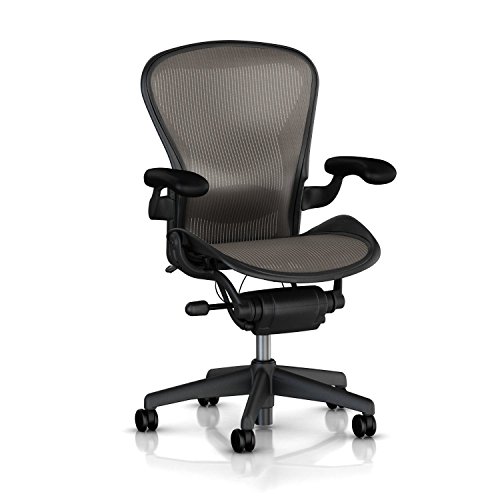
What We Like
- Breathable Pellicle suspension dissipates heat
- Kinemat tilt keeps body natural alignment
- Waterfall seat edge reduces thigh pressure
- 12-year Herman Miller warranty
Trade-offs
- At 48 lb, it's heavy to move around
- No headrest for upper back support
The patented Kinemat tilt mechanism lets your neck, shoulders, hips, knees, and ankles pivot naturally, which helps maintain comfort during long work sessions. Its breathable Pellicle suspension dissipates body heat, keeping you cool and comfortable while providing support. The waterfall front edge takes pressure off your thighs, so your blood keeps circulating, keeping you alert and focused. This chair suits someone who values airflow and natural movement, making it a good choice for those who sit for extended periods.
That said, the 48-pound weight makes it a beast to slide across carpet or reposition frequently, and the lack of a headrest means upper back and neck support come entirely from your own posture. Compared to the Steelcase Amia, which offers four points of adjustability, the Aeron focuses on breathability and a more active sitting experience. If you prefer a chair that moves with you, this is a strong option. The 12-year warranty adds peace of mind for such a long-term investment.
Product photos
Steelcase Amia Office Chair
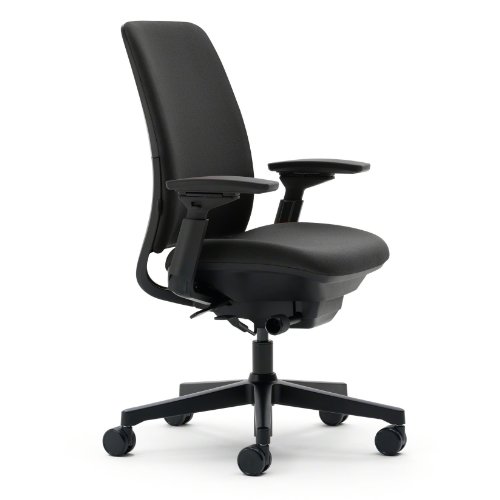
What We Like
- LiveLumbar adjusts to your movement
- 4D arm support for personalized fit
- Extra cushioning for 8-10 hour comfort
Trade-offs
- At 54.5 lb, it's heavy to move
- No headrest for full neck support
The hidden LiveLumbar system in this chair adjusts to your movement, providing dynamic lower back support that adapts as you shift positions throughout the day. That responsive support is what makes it a standout for anyone who spends long hours at a desk and needs relief that adapts, not just a static pad. The extra cushioning and flexible seat edges help you sit pressure-free for eight to ten hours, and the 4D armrests let you dial in height, width, pivot, and depth exactly where your arms fall naturally. It’s a chair built for sustained comfort without constant readjustment.
At 54.5 pounds, this is a substantial chair that you won’t want to move from room to room. If you rearrange your workspace often or need something light, the Marsail Ergonomic Office Chair is a lighter alternative at 30.4 pounds. The Amia also does not include a headrest, so if you need neck support for reclining, you may want to look at models that include one. For focused, all-day desk work with lower back pain in mind, the Amia’s adaptive support is hard to beat.
Haworth Breck Ergonomic Office Chair

What We Like
- Height-adjustable lumbar support
- 4D armrests for personalized positioning
- Weight-activated recline with 3-position backstop
- Adaptive seat depth reduces pressure behind knees
Trade-offs
- 38-pound weight limits easy mobility
The Haworth Breck’s height-adjustable lumbar support lets you dial in exactly the lower back pressure you need, making it a strong pick for anyone whose back pain shifts throughout the day. The 4D armrests move every which way, so you can keep your shoulders relaxed while typing or reading. Its weight-activated recline responds to your body without fiddling with tension knobs, and the three-position backstop means you can lock in upright focus or let it rock back during a brainstorming session. For someone who values precise lower back customization above all else, this chair delivers that fine-tuning without overwhelming you with levers.
The Haworth Breck’s 38-pound frame makes it a heavy-duty chair, so expect a solid, planted feel during use. Its adjustability is focused on lumbar height and seat depth, allowing you to fine-tune lower back support and thigh positioning. This chair skips extra features like a headrest, concentrating instead on core ergonomic adjustments for those who prioritize lumbar comfort.
Product photos
Herman Miller Embody Ergonomic Office Chair
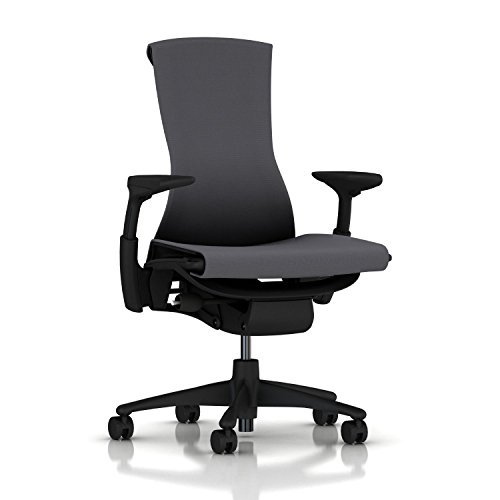
What We Like
- Developed with over 20 physicians and PhDs
- Backfit adjustment aligns with spine's curve
- Pixelated support distributes weight evenly
- Four support layers with airflow design
Trade-offs
- At 52 pounds, it's heavy to move
- Weighs 52 pounds, making it less portable
More than 20 physicians and PhDs in biomechanics, vision, physical therapy, and ergonomics contributed to this chair’s design, so every adjustment aims to support natural posture. The Backfit adjustment lets you align the backrest with your spine’s curve, while Pixelated Support, a matrix of pixels, conforms to your movements and distributes weight evenly, reducing pressure during long sits. This makes it ideal for anyone who needs a chair that adapts as they shift.
Compared to the lighter Haworth Soji (19.8 pounds), the Embody is heavier and better suited for a dedicated desk spot. For those who prioritize expert-backed ergonomics over portability, this chair is a strong option.
Product photos
Humanscale World One Office Chair
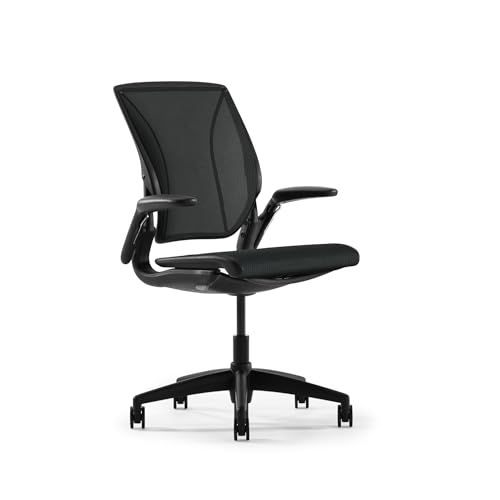
What We Like
- Self-adjusting lumbar support for custom fit
- Weight-sensitive recline adapts to movement
- Breathable tri-panel mesh back for comfort
- Frameless front edge reduces knee pressure
Trade-offs
- No adjustable lumbar tension for manual control
- Lacks armrest adjustability information
The Humanscale World One’s self-adjusting lumbar support is its standout feature: instead of a manual dial or lever, the backrest automatically contours to your spine as you shift, so you never have to stop and tweak a setting. The weight-sensitive recline (from 14 to 27.75 inches seat height) means the chair moves with your body, giving you a custom fit that changes as you lean forward or back. This makes it an excellent pick if you want lumbar support that adapts without any fuss, especially during long stretches at a desk.
You lose hands-on control over the lumbar curve with this design; some people prefer to dial in a specific firmness, which you can’t do here. The frameless front edge does help reduce knee pressure, and the breathable mesh back keeps you cool, but if you need to lock in a precise lumbar angle, this self-adjusting design may feel too passive.
Product photos
Steelcase Gesture Office Chair
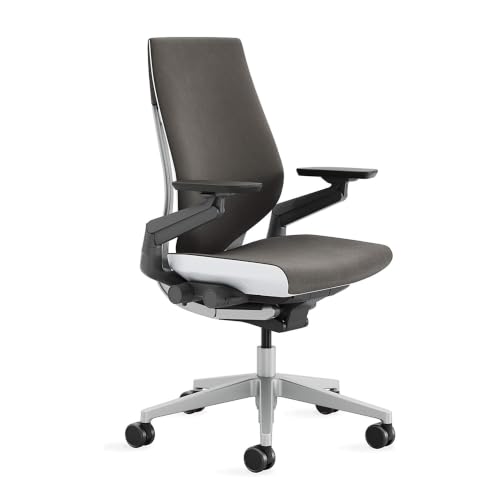
What We Like
- 360-degree arms for any posture
- Contoured back supports spine's natural shape
- Full recline range with three settings
- Intuitive adjustments within arm's reach
Trade-offs
- At 70 lb, it's heavy to move
- Wheels designed for carpet floors
The Gesture’s 360-degree arms and contoured back that follows your spine’s natural curve mean you can find a comfortable position for just about any task. Whether typing, leaning back to think, or reaching for something on your desk, the chair adapts easily. This chair is built for people who spend long hours seated and want a precise, personalized fit without hunting for levers or knobs. The intuitive adjustments are all on the right side, right where your hand falls. It’s a premium choice for anyone who values effortless adaptability and solid lumbar support throughout the workday.
At 70 pounds, the Gesture is a heavy chair that you’ll want to set up and leave in place, and its wheels are designed for carpet so it rolls smoothly on that surface. Compared to the Haworth Soji at under 20 pounds, the Gesture is far less portable, but its sturdy build and advanced arm adjustability offer a level of customization that the Soji’s simpler design can’t match. If you need a chair that stays put and adapts to you, the Gesture delivers, just plan to set it up and leave it.
Product photos
How We Evaluated Office Chairs For Lower Back Pain
We researched each chair’s specifications, manufacturer documentation, and expert round-ups. We also analyzed patterns in owner feedback to understand what features actually help with lower back pain over long sitting sessions. This research-led approach identifies the chairs most likely to provide relief.
Our top criteria were lumbar adjustability, seat cushion thickness and density, backrest design, and overall build quality. For lower back pain, a chair must offer more than just a lumbar pillow, it needs adjustable support that matches your spine’s curve. We prioritized chairs with multiple points of adjustment.
A research-based evaluation has limits. We cannot replicate months of daily use, and individual body types respond differently to each chair. We recommend using this guide to narrow your options, then trying your top picks in person if possible.
What To Look For In Office Chairs For Lower Back Pain
Choosing an office chair for lower back pain means looking beyond basic ergonomic claims. The right chair will support your spine’s natural curve, distribute your weight evenly, and allow you to sit comfortably for hours.
Look for adjustable lumbar support that moves both up and down and forward and backward. A thick, high-density foam seat cushion and a breathable backrest help you stay comfortable longer.
Adjustable Lumbar Support
The most important feature for lower back pain is lumbar support that you can customize. Look for chairs that allow you to adjust the lumbar pad both vertically (up and down) and in depth (forward and backward). Some chairs, like the CAPOT, offer micro-adjustments with multiple levels. Others, like the Steelcase Amia, use dynamic lumbar support that moves with your body.
Seat Cushion Thickness and Density
A thin or low-density seat cushion can cause pressure points that worsen back pain. Look for high-density foam at least three inches thick. The Marsail uses a 3.14-inch thick high-density foam cushion, while the CASASIO uses 3.5 inches of virgin foam. A waterfall seat edge, like on the Herman Miller Aeron, also reduces pressure behind your knees.
Backrest Design and Breathability
A solid backrest can trap heat and cause discomfort. Mesh backrests, like those on the CAPOT and Humanscale World One, allow air to circulate and keep you cool. The Herman Miller Aeron uses a Pellicle suspension that dissipates heat. For lower back pain, the backrest should also support your spine’s natural curve from the lumbar region through your shoulders.
Build Quality and Warranty
A chair that wobbles or wears out quickly will not support your back over time. Look for chairs with long warranties, the Haworth Soji and Herman Miller Aeron both offer 12-year coverage. Steelcase chairs are known for their durable construction. Weight capacity is also important; the CAPOT supports up to 400 pounds.
- Test the lumbar adjustment range: can you feel the pad move against your lower back?
- Sit in the chair for at least 15 minutes to assess seat cushion comfort.
- Check that the armrests adjust to a height that lets your shoulders relax.
- Measure your desk height to ensure the chair’s seat height range works.
- Consider the chair’s weight if you need to move it between rooms.
A chair with adjustable lumbar support and a thick seat cushion is the minimum for managing lower back pain.
Office Chairs For Lower Back Pain Compared
The table below compares all ten chairs side by side, focusing on the features that matter most for lower back pain relief.
| Product | Lumbar Support | Weight Capacity | Armrests |
|---|---|---|---|
| Marsail Ergonomic Office Chair | Adjustable 1.18" forward/backward, 2.16" up/down | 330 lbs | 3D adjustable, flip-up PU-padded |
| CASASIO Ergonomic Office Chair | 4-way adjustable | 330 lbs | Flip-up |
| CAPOT Ergonomic Mesh Office Chair | 2 inches, 8 levels | 400 lbs | 4D Flip-up |
| Haworth Soji Ergonomic Office Chair | Adjustable | 350 lb | 4D adjustable |
| Herman Miller Classic Aeron Task Chair | Lumbar Pad | N/A | Fully Adj Vinyl Arms |
| Steelcase Amia Office Chair | LiveLumbar dynamic system | N/A | 4D (height, width, pivot, depth) |
| Haworth Breck Ergonomic Office Chair | Height-adjustable | N/A | 4D (vertical, horizontal, forward/backward, pivot) |
| Herman Miller Embody Ergonomic Office Chair | N/A | N/A | Fully adjustable |
| Humanscale World One Office Chair | Self-adjusting, built-in | 300 lbs | N/A |
| Steelcase Gesture Office Chair | N/A | N/A | 360-degree arms |
Frequently Asked Questions
What type of office chair is best for lower back pain?
An ergonomic chair with adjustable lumbar support is best for lower back pain. Look for a chair that allows you to adjust the lumbar pad both vertically and in depth, so you can match the support to your spine’s curve. A thick, high-density foam seat cushion and a breathable backrest also help.
How much should I spend on an office chair for back pain?
The best chairs for lower back pain range from budget-friendly to premium. The key is to prioritize adjustability and build quality over price. A mid-range chair with good lumbar support can be more effective than a premium chair without it. Focus on features, not cost.
Can a mesh office chair help with lower back pain?
Yes, a mesh office chair can help by keeping you cool and supporting your spine’s natural curve. Mesh backrests conform to your body and allow air to circulate, which reduces discomfort during long sitting sessions. Look for mesh chairs with adjustable lumbar support for the best results.
Is a headrest important for lower back pain?
A headrest is not essential for lower back pain, but it can help with overall posture. If you lean back frequently, a headrest supports your neck and upper spine, which can reduce strain on your lower back. Some chairs, like the CASASIO, include a 3D adjustable headrest.
How long should an office chair last for back pain relief?
A well-built office chair should last at least five to ten years. Chairs with longer warranties, such as the Haworth Soji and Herman Miller Aeron with 12-year coverage, are built to last longer. A durable chair maintains its support over time, which is critical for managing back pain.
The Bottom Line
The Marsail Ergonomic Office Chair is our best overall pick for lower back pain. Its 3.14-inch thick high-density foam seat cushion and adjustable lumbar support (1.18 inches forward and backward, 2.16 inches up and down) provide the customization most people need. It is ideal for anyone who wants a highly adjustable chair with thick cushioning and breathable mesh.
If you need all-day comfort, the CASASIO Ergonomic Office Chair offers a 3.5-inch virgin foam seat and a 4-way adjustable lumbar cushion. For precise lumbar control, the CAPOT Ergonomic Mesh Office Chair features 8-level micro-adjust lumbar support. Budget-conscious shoppers should consider the Haworth Soji for its lightweight design and long warranty.
The single most important factor for lower back pain is adjustable lumbar support that matches your spine’s curve. No other feature matters as much. Choose a chair that lets you dial in the exact support your back needs.
