10 Best Bench Jointers in 2026
This post contains affiliate links. As an Amazon Associate, we earn from qualifying purchases.
For home woodworkers who need a straight, flat edge on boards without taking over the garage, the Cutech 40180HI 8-Inch Spiral Cutterhead Jointer is the best overall bench jointer. It delivers an 8-inch cutting width and a spiral cutterhead for a smooth finish, all in a benchtop package. For those with a premium budget, the JET 6-Inch Benchtop Helical Head Jointer offers exceptional build quality, while the WEN 6-Inch Spiral Benchtop Jointer provides a great value spiral cutterhead.
The challenge with a bench jointer is balancing capacity, power, and footprint. You need a machine that can handle your typical board widths, fits on your workbench, and doesn’t require a dedicated circuit. A jointer that is too small limits your projects, while one that is too large or heavy becomes impractical for a home shop.
This guide is based on a thorough analysis of manufacturer specifications, expert woodworking round-ups, and patterns in owner feedback. We evaluated ten models across key criteria like cutterhead type, table stability, motor power, and overall value to help you find the right fit for your workshop.
Top 10 Bench Jointers in the Market
Certain content that appears on this site comes from Amazon. This content is provided "as is" and is subject to change or removal at any time.
The Best Bench Jointers, Reviewed
Cutech 40180HI 8-Inch Spiral Cutterhead Jointer

What We Like
- 8-inch spiral cutterhead with 16 TC inserts
- Cast iron tables for stability
- Extra-long 24-inch aluminum fence
- Fence enhancement brackets for precision
Trade-offs
- At 34 inches long, needs ample bench space
- Weighs 71 pounds, challenging to move frequently
The spiral cutterhead uses staggered tungsten carbide inserts that draw less power than comparable designs, so you can work through dense hardwoods without straining a 10-amp motor. Cast iron tables provide a flat, stable surface for edge jointing, and the 24-inch aluminum fence locks at 90° and 135° for quick angle changes. Owners say the extra-long fence and support rods keep the frame rigid during heavy cuts.
At 34 inches long with cast iron tables, this jointer needs a dedicated workbench and isn’t meant for job-site portability. The WEN JT833H offers an extendable table for occasional mobility, but the Cutech’s fixed cast iron build gives it a more planted feel under load. If you have a permanent shop and prioritize stability over packing up, this suits that setup.
JET 6-Inch Benchtop Helical Head Jointer

What We Like
- Helical head with 14 four-sided carbide inserts
- Cast iron tables for stability
- Built-in dust collection with filter bag
- 5-year warranty
Trade-offs
- At 71 lb, it's heavy for a benchtop model
- Requires a dedicated 15A circuit
- Only handles stock up to 6" wide
A helical cutterhead with 14 four-sided carbide inserts shears wood at an angle for a smooth surface. Each insert can be rotated to a fresh edge instead of resetting straight knives. That head sits on cast iron tables and a 1 HP motor that removes up to 1/8″ per pass, backed by a 5-year warranty, so it’s built for woodworkers who want a durable, precision tool in a benchtop format.
The trade-off is weight: at 71 pounds, this jointer is heavier than some benchtop competitors, which makes it less portable and more demanding on your workbench. You’ll also need a dedicated 15A circuit to run it at full power. But if your shop can handle the heft and the electrical requirement, the JET delivers stable performance and smooth cuts that lighter machines may not match.
WEN 6-Inch Spiral Benchtop Jointer
What We Like
- Spiral cutterhead for ultra fine finish
- Spacious 30-by-6-inch table
- Adjustable fence bevels up to 45°
- Removes up to 1/8 inch per pass
Trade-offs
- HSS blades dull faster than carbide inserts
- At 36.8 lb, not as portable as lighter models
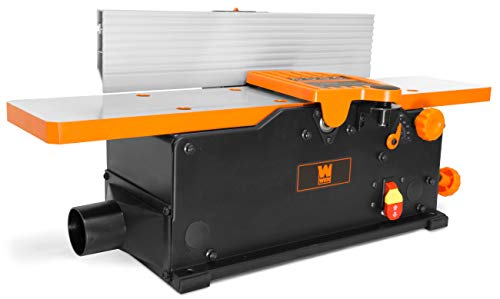
A spiral cutterhead with 12 staggered HSS blades produces an ultra fine finish, so you get clean edges with less sanding. The 30-by-6-inch table offers plenty of room for face jointing smaller boards, and the fence tilts up to 45 degrees for beveled cuts. That’s a lot of capability for the price.
The HSS blades work well on softwoods and hardwoods but won’t hold an edge as long as the carbide inserts found on the JET 6-Inch Helical Head Jointer. That means you’ll swap or rotate blades more often if you work with abrasive or exotic woods. For a weekend woodworker who values a smooth finish and lower upfront cost, this WEN is a smart choice.
Cutech 40160HB 6-Inch Spiral Cutterhead Jointer

What We Like
- Spiral cutterhead for smooth finish
- Two-sided inserts reduce skewing
- Teflon-coated table resists scratches
Trade-offs
- 6-inch width limits wider boards
- Aluminum tables less durable than cast iron
The 6-inch cutting width limits you to narrower boards, so if you regularly work with stock wider than six inches, an 8-inch model like the Cutech 40180HI would be a better fit. The aluminum tables are lighter and easier to move than cast iron, though some owners note that cast iron absorbs vibration better. For home woodworkers who want a smooth finish without needing heavy electrical upgrades, this jointer fits well.
WEN 8-Inch Spiral Benchtop Jointer
What We Like
- Spiral cutterhead with 16 HSS blades
- Extendable table reaches 51 inches
- Adjustable fence bevels up to 45°
- Removes up to 1/8 inch per pass
Trade-offs
- HSS blades, not carbide inserts
- Base table is 33 inches without extensions
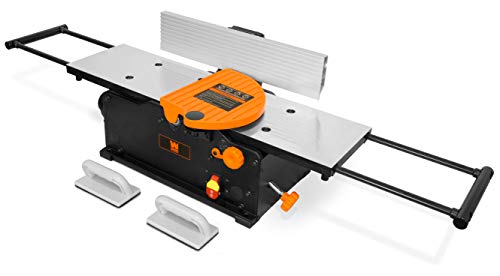
An 8-inch spiral benchtop jointer with support arms that stretch the table from 33 to 51 inches means you can flatten longer boards without wrestling them off the end. That extended reach is the reason this model stands out for anyone who regularly works with stock over three feet. It suits the home woodworker who wants 8-inch capacity and the flexibility to handle longer workpieces without upgrading to a floor-standing machine.
WOODERS 6-Inch Benchtop Jointer
What We Like
- 15-amp pure copper motor for hardwoods
- Ergonomic design reduces hand fatigue
- Compact 21-lb portable build
- Fence tilts 90° to 135° for bevels
Trade-offs
- 1/8" max cut depth limits heavy material removal
- 6-inch width won't handle wider boards
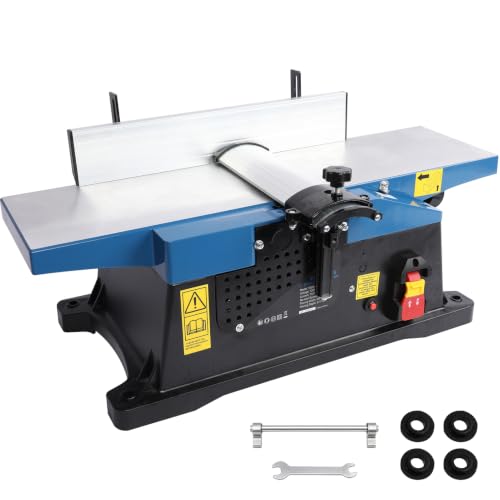
The trade-off is a 6-inch cutting width and a maximum depth of 1/8 inch, which limits how much material you can remove in a single pass. If you regularly joint wider boards or need deeper cuts, the Cutech 40180HI offers an 8-inch capacity. But for someone starting out or working in a small shop, the WOODERS combination of power, portability, and ergonomic ease makes it a practical choice.
Product photos
Wahuda Tools 8-Inch Spiral Cutterhead Jointer
What We Like
- Cast iron tables with pull-out extensions
- 4-sided carbide inserts for sharp cuts
- 120V 10A motor at 12,000 RPM
- Fence tilts 90° to 135°
Trade-offs
- At 34 inches long, needs dedicated bench space
- No built-in mobile base for portability
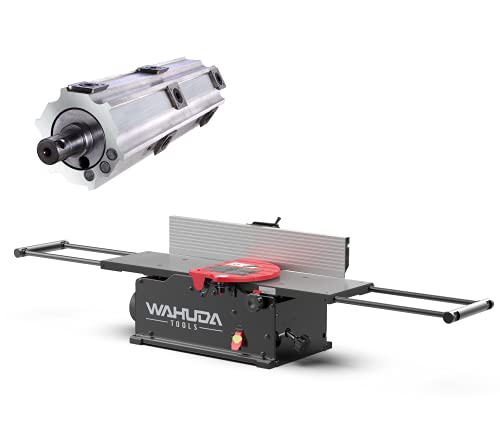
The 12,000 RPM motor handles edging, jointing, flattening, or tapering on any surface, so you can work through tough or figured woods without slowing down. The spiral cutterhead uses four-sided carbide inserts for sharper and quieter cutting precision, and the adjustable cast iron tables with pull-out extensions enhance stability when working on longer, larger pieces. It’s perfect for job sites or small shops where you need a movable benchtop jointer that still delivers accurate cuts.
Product photos
WOODSTARTER 6-Inch Benchtop Jointer
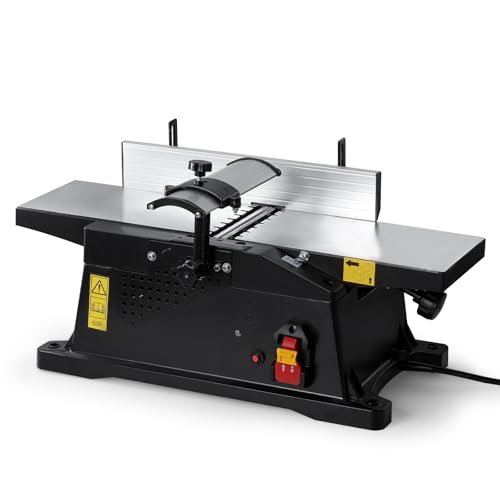
What We Like
- 15 Amp motor for hardwoods
- Adjustable fence 90°–135°
- Compact at 21 lbs
- Dual HSS blades included
Trade-offs
- 6-inch width limits wider boards
- HSS blades dull faster than carbide
Its 6-inch cutting width suits smaller stock like shelving boards and furniture parts, and the adjustable fence tilts from 90° to 135° for beveled joints. That combination of power and portability makes it a smart choice for hobbyists and beginners who want a capable machine without a big footprint.
The 6-inch cutting width means you can’t joint wider panels in one pass, so you’ll need multiple passes for boards over that size. The included HSS blades are sharp out of the box, but some competing models use carbide inserts, which owners report hold an edge longer in heavy use. For someone focused on smaller projects, that’s a manageable compromise.
Product photos
Rikon 6-Inch Helical Cutterhead Jointer

What We Like
- Low-friction synthetic polymer coated tables
- Helical cutterhead with 12 two-sided inserts
- Easy read depth scale
- Safety on/off switch
Trade-offs
- At 36 lb, it's portable but not ultra-light
- 6-inch width limits wider boards
- Table length under 20 inches for shorter stock
The synthetic polymer coated aluminum tables are the standout feature here, they reduce friction and resist scratches, so boards glide smoothly without the drag you get on bare metal. This makes it especially nice for lighter workpieces or when you’re feeding stock repeatedly, as the low-friction surface keeps passes consistent. With a helical cutterhead carrying 12 two-sided inserts, you get quieter operation and a cleaner finish than straight knives, and the easy read depth scale takes the guesswork out of setting your cut. It’s a thoughtful design for a benchtop jointer that prioritizes ease of use and a smooth workflow.
At 36 pounds, this jointer is light enough to stow on a shelf or carry to a job site, but its 19 3/4-inch table limits you to shorter boards. The JET model is nearly twice as heavy with a longer table, so it stays planted during passes but is a pain to move. If you mostly joint small stock and want a machine that won’t dominate your bench, this one fits the bill.
Product photos
VIGO POWER 6-Inch Spiral Cutterhead Jointer
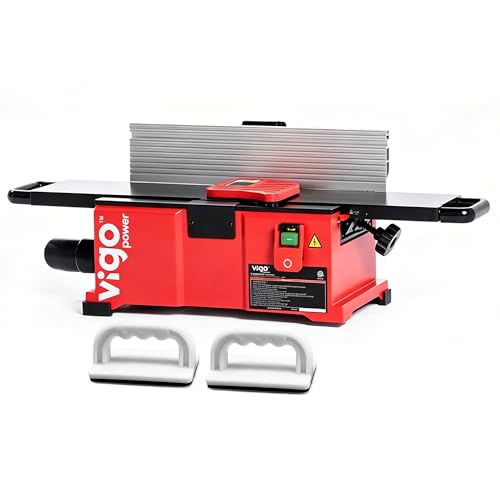
What We Like
- Four-sided carbide inserts for long life
- 12-amp motor with 9,000 RPM
- Adjustable fence from 90 to 135 degrees
- Includes spare inserts and push blocks
Trade-offs
- 6-inch capacity limits wider boards
- Dust bag sold separately for chip collection
- No built-in table extensions for long workpieces
The 12-amp motor spins the spiral cutterhead at 9,000 RPM, letting you joint boards up to 6 inches wide with a smooth finish. Each of the 12 carbide inserts has four usable edges, so you can rotate them as they dull instead of replacing the whole set, and three spares are included to keep you working. This is a smart pick for the home woodworker who wants consistent results without constantly buying new blades.
The 6-inch width limit means you can’t flatten an 8-inch board in one pass like the Cutech 40180HI can. You’ll also need to buy a dust bag or connect a shop vacuum to the 2-1/2-inch port, since one isn’t included. For the hobbyist who works with common board widths and values long-lasting carbide edges, this jointer delivers real value.
Product photos
How We Evaluated Bench Jointers
This guide is based on manufacturer documentation, expert woodworking round-ups, and patterns in owner feedback. We focused on the specifications and real-world reports that matter most to home woodworkers.
We prioritized four criteria. First, cutterhead type: spiral and helical heads with multiple inserts produce a finer finish and quieter operation than straight knives. Second, table construction: cast iron provides superior stability and vibration dampening compared to aluminum. Third, cutting capacity: the 6-inch versus 8-inch width determines what size boards you can joint. Finally, motor and power requirements: a 15-amp motor on a standard 120V circuit is ideal for most home shops.
A research-led evaluation has limits. Owner feedback can vary based on individual setup and usage, and specifications don’t always predict real-world performance. We recommend using this guide to narrow your options, then checking the return policy and warranty for your final choice.
What To Look For In Bench Jointers
Choosing a bench jointer means matching its specs to your typical projects and workshop constraints. The right machine will give you flat edges and faces for years to come.
Focus on cutterhead type, with spiral or helical designs offering the best finish. Table material matters, and cast iron provides stability for accurate cuts. Cutting width should match your projects: 6 inches handles most boards, while 8 inches works for wider stock. Motor power is also key, and 15 amps on a standard 120V circuit is ideal for consistent performance.
Cutterhead Type
The cutterhead is the heart of the jointer. Straight knives are traditional but produce more noise and tear-out on figured wood. Spiral and helical cutterheads use multiple small inserts arranged in a spiral pattern. They cut more smoothly, run quieter, and the inserts can be rotated or replaced individually when dull. Carbide inserts last much longer than high-speed steel (HSS) blades, making them a better long-term value for frequent use.
Table Size and Material
The infeed and outfeed tables support your workpiece. Longer tables help flatten longer boards. Cast iron tables are heavy and absorb vibration, giving a smoother cut. Aluminum tables are lighter and more portable but can flex under pressure. Look for tables that are flat and true, with a smooth surface that won’t scratch your workpieces.
Cutting Width and Depth
A 6-inch jointer handles the majority of common board widths, from 1x4s to 2x6s. An 8-inch jointer lets you face-joint wider stock like 1x8s or small panels. The maximum depth of cut (usually 1/8 inch) determines how much material you can remove per pass. Deeper cuts speed up rough stock removal, but lighter passes produce a finer finish.
- Measure the widest boards you typically work with and choose a jointer that can handle them.
- Check your workshop’s electrical setup: most bench jointers run on a standard 120V, 15-amp circuit.
- Consider the jointer’s weight and footprint: a heavy model needs a sturdy bench and is not easily moved.
- Look for a fence that tilts (typically 90° to 135°) for beveling edges.
- Verify the dust port size to ensure it connects to your shop vacuum or dust collection system.
A good rule of thumb: buy the widest jointer your budget and bench space allow, as you can always joint a narrow board on a wide jointer but not the reverse.
Bench Jointers Compared
The table below compares the key specifications of our top ten bench jointers, so you can see at a glance how they stack up on cutterhead type, table material, cutting width, and weight.
| Product | Cutterhead | Motor | Max Cut Depth |
|---|---|---|---|
| Cutech 40180HI 8-Inch Spiral Cutterhead Jointer | 8-inch spiral, 16 TC inserts | 10-amp | N/A |
| JET 6-Inch Benchtop Helical Head Jointer | Helical, 14 carbide inserts | 1 HP, 115V, 15A | 1/8" |
| WEN 6-Inch Spiral Benchtop Jointer | 12 staggered HSS blades | 10-Amp | 1/8 inch |
| Cutech 40160HB 6-Inch Spiral Cutterhead Jointer | Spiral with 6 rows; 12 two-sided TC inserts | 10-amp | N/A |
| WEN 8-Inch Spiral Benchtop Jointer | 16 HSS blades spiral | 10-Amp | 0 to 1/8 in |
| WOODERS 6-Inch Benchtop Jointer | N/A | 15-Amp, 13000 RPM | 1/8 inch |
| Wahuda Tools 8-Inch Spiral Cutterhead Jointer | Spiral, 4-sided carbide inserts | 120V, 10A, 12,000 RPM | N/A |
| WOODSTARTER 6-Inch Benchtop Jointer | N/A | 15 Amp, 12000 RPM | 1/8 inch |
| Rikon 6-Inch Helical Cutterhead Jointer | Helical with 12 inserts | N/A | N/A |
| VIGO POWER 6-Inch Spiral Cutterhead Jointer | Spiral, 12 carbide inserts | 12A, 9,000 RPM | 1/8 inch |
Frequently Asked Questions
What is the difference between a spiral and helical cutterhead?
Both use multiple inserts arranged in a pattern for a smoother cut than straight knives. A helical cutterhead typically uses four-sided carbide inserts that can be rotated for extended life, while spiral cutterheads may use HSS blades or two-sided inserts. Helical heads are generally more expensive but offer longer insert life.
Can a bench jointer handle hardwood like oak or maple?
Yes, most bench jointers with a 15-amp motor can handle hardwoods. The key is taking light passes and using sharp blades or inserts. Models with carbide inserts are better suited for abrasive or dense hardwoods as they stay sharp longer than HSS blades.
What size bench jointer do I need for furniture making?
For most furniture projects, a 6-inch jointer is sufficient for edge jointing and face jointing boards up to 6 inches wide. If you frequently work with wider stock like table tops or cabinet panels, an 8-inch jointer gives you more flexibility. Consider the longest boards you will joint and look for a model with longer tables.
How much bench space does a bench jointer require?
Bench jointers vary in length from about 20 inches to over 50 inches with extensions. A typical 6-inch model needs around 30 inches of bench depth, while an 8-inch model with extensions can require more than 50 inches. Always measure your available bench space before purchasing.
Is a spiral cutterhead worth the extra cost?
For most woodworkers, yes. Spiral and helical cutterheads produce a noticeably smoother finish, reduce tear-out on figured wood, and run more quietly than straight knives. The inserts last longer and are easier to replace. The initial higher cost is often offset by lower blade replacement costs and less time spent sanding.
The Bottom Line
For the home woodworker who wants the best balance of cutting width, finish quality, and value, the Cutech 40180HI 8-Inch Spiral Cutterhead Jointer is our top recommendation. Its 8-inch spiral cutterhead with carbide inserts delivers a smooth finish on wide boards, and the cast iron tables provide the stability you need for accurate work. It is ideal for serious DIYers who have a sturdy workbench and work with stock up to 8 inches wide.
If your budget allows for a premium build, the JET 6-Inch Benchtop Helical Head Jointer offers exceptional quality and a 5-year warranty. However, it requires a dedicated 15-amp circuit. For those seeking the best value in a spiral cutterhead, the WEN 6-Inch Spiral Benchtop Jointer provides a smooth finish at a more accessible price point. The WOODSTARTER 6-Inch Benchtop Jointer is a solid budget-friendly choice for hobbyists.
The single most important factor in choosing a bench jointer is matching the cutting width to your most common projects. A 6-inch model handles the vast majority of home workshop needs, but an 8-inch model gives you the flexibility to work with wider boards and panels. Measure your stock and your bench space, then choose the jointer that fits both.
