10 Best Under Sink Reverse Osmosis Systems in 2026
This post contains affiliate links. As an Amazon Associate, we earn from qualifying purchases.
The Waterdrop G3P600 Tankless RO System earns our best overall spot for its NSF/ANSI 58 certification, space-saving tankless design, and smart faucet that displays TDS and filter life in real time. For households needing faster flow, the Waterdrop G3P800-WCK delivers 800 GPD, while the iSpring RO500AK offers certified value with alkaline water.
Choosing an under sink reverse osmosis system means balancing filtration quality, flow rate, and cabinet space. Tankless models save room but need an electrical outlet, while tank-based systems work without power but take up storage area. Water efficiency and filter replacement costs also factor into the long-term value.
Our research-based evaluation draws from manufacturer specifications, NSF certification data, expert round-ups, and patterns in owner feedback. We focused on the criteria that matter most: certified contaminant reduction, flow rate, water efficiency, and installation requirements. This guide helps you match the right system to your kitchen and water needs.
Top 10 Under Sink Reverse Osmosis Systems in the Market
Certain content that appears on this site comes from Amazon. This content is provided "as is" and is subject to change or removal at any time.
The Best Under Sink Reverse Osmosis Systems, Reviewed
Waterdrop G3P600 Tankless RO System

What We Like
- NSF/ANSI 58 certified for TDS reduction
- Smart faucet with TDS and filter life display
- 2:1 low drain ratio saves water
- Tool-free 3-second filter changes
Trade-offs
- Requires under-sink electrical outlet nearby
- At 32 lb, heavier than some tankless models
A 600-gallon-per-day output means this system keeps up with a busy kitchen, filling an 8-ounce cup in just 8 seconds. That flow rate is fast enough for rinsing vegetables or filling a pot without waiting. The 2:1 pure-to-drain ratio produces only one cup of wastewater for every two cups of filtered water, so you are not sending most of your water down the drain. Owners appreciate that the tankless design frees up about 70 percent of under-sink space compared to traditional systems with storage tanks. Filter changes take about three seconds and require no tools, which makes maintenance simple. The smart faucet displays both TDS levels and filter life, so you always know the water quality and when to swap a cartridge.
The trade-off is that this system needs electricity under the sink, which means you’ll need an outlet nearby or be ready to have one installed. At 32 pounds, it’s heavier than the Philips Aquaporin RO system (22 lb), so reviewers note that mounting it securely takes a bit more care. But if you have the power access and want a certified, high-flow system with a clear display and easy filter swaps, the Waterdrop G3P600 delivers without taking over your cabinet.
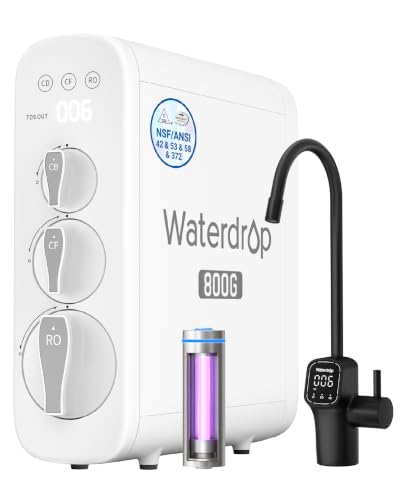
Waterdrop G3P800-WCK RO System
What We Like
- 800 GPD fast flow rate
- 10-stage filtration with LED purification
- Smart faucet with TDS display
- 3:1 pure-to-drain ratio
Trade-offs
- Heavier than many competitors at 33.7 lbs
- Smart faucet requires power outlet near sink
An 800 GPD flow rate means this system can fill a glass in seconds and keep up during a busy kitchen, from morning coffee to dinner prep. The 10-stage filtration, topped off with LED purification, goes beyond standard RO to tackle TDS, chlorine, and fluoride, so every drop feels cleaner. That smart faucet with real-time TDS readings and filter-life alerts takes the guesswork out of maintenance, making it a strong fit for households that want high capacity without constant monitoring.
At 33.7 pounds, this system is heavy enough that you’ll want a sturdy cabinet floor or a helper during installation. The iSpring RO500AK, by contrast, weighs just 21 pounds and is easier to maneuver into tight spaces. The 18.1-inch length means it can fit under most standard sinks, but if your cabinet is cramped, measure first to avoid a squeeze. For buyers who have the room and want fast flow plus extra purification stages, this unit delivers; those with limited space or who prefer a lighter setup might lean toward the iSpring.
Product photos
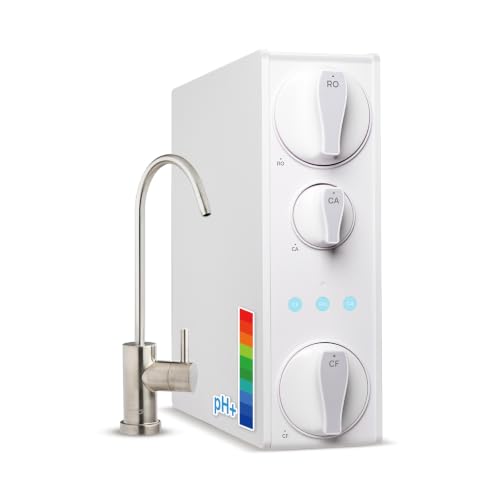
iSpring RO500AK Alkaline RO System
What We Like
- NSF 58 certified for TDS reduction
- Alkaline filter adds minerals for taste
- 2:1 low drain ratio saves water
- Auto flush and filter reminder lights
Trade-offs
- Requires access to electricity
- Heavier than some tankless models at 21 lb
The entire unit is NSF 58 certified, meaning every component has been independently tested for performance and safety, not just a few parts. It delivers up to 0.4 GPM real flow, filling a small cup in about 10 seconds, so it handles a busy kitchen without needing a storage tank. The alkaline remineralization filter adds beneficial minerals back into the water, which can give it a fresher, smoother taste compared to standard RO water.
Because it’s tankless, this system requires a power outlet under the sink, so plan your setup accordingly. At 21 pounds, it’s actually lighter than the Philips Aquaporin system, which may make solo installation a bit easier. The 2:1 pure-to-waste ratio saves up to 400% water compared to older RO units, and the auto-flush feature protects the membrane after 24 hours of non-use.
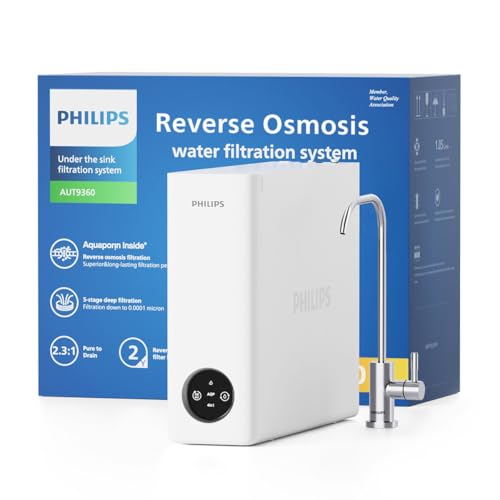
Philips Aquaporin RO System
What We Like
- Biomimetic membrane with aquaporin proteins
- 600 GPD fills 8 oz cup in ~8 seconds
- 2.3:1 pure-to-drain ratio saves water
- Auto-cycle self-flushing extends membrane life
Trade-offs
- Requires under-sink power outlet
- Requires a sink hole for faucet installation
A 600 GPD flow rate means this tankless system fills a small cup in about eight seconds, so you’re never waiting for a glass of cooking water or coffee. The real story here is the biomimetic Aquaporin membrane, which uses proteins inspired by nature to filter down to 0.0001 micron. That level of precision reduces TDS, chlorine, and particulates while maintaining a 2.3:1 pure-to-drain ratio, making it more water-efficient than many conventional RO units. It’s a smart pick if you want cutting-edge filtration and don’t mind a compact footprint that still requires a power outlet under the sink.
The auto-cycle self-flushing helps keep the membrane performing without manual maintenance, and the twist-and-replace filters make changes tool-free. If you’re after the most innovative filtration technology in a space-saving design and can handle the electrical requirement, this system delivers fast, efficient water with a two-year warranty to back it up.
Product photos
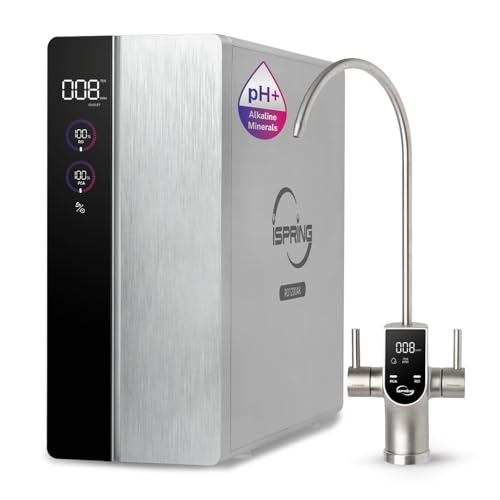
iSpring RO1200AK Dual-Flow RO System
What We Like
- Dual-flow faucet saves membrane life
- 1200 GPD fills cup in 5 seconds
- 3:1 pure-to-drain ratio cuts wastewater
- Smart TDS monitor and filter reminders
Trade-offs
- Requires electrical outlet for operation
- At 26.4 lb, heavier than some tankless models
A 1200 GPD output means this tankless system fills a small cup in about 5 seconds, making it one of the fastest under-sink reverse osmosis options available. The clever Dual-Flow faucet lets you use carbon-filtered water for rinsing produce and RO+alkaline water for drinking from the same tap, which reduces wear on the membrane over time. With a 3:1 pure-to-drain ratio, it wastes less water than many conventional systems, and the built-in TDS monitor and filter reminders take the guesswork out of maintenance. This is a strong pick for households that want quick, mineral-enhanced water without a bulky storage tank.
One catch is that the system needs a nearby electrical outlet to run its pump and auto-flush feature, which may limit placement in some cabinets. At 26.4 pounds, it is heavier than the Philips model (22 pounds), so you will want a sturdy cabinet floor. But if you prioritize speed and a smarter faucet design that extends membrane life, the iSpring RO1200AK delivers on both fronts without the tank taking up space.
VIOMI V8 PRO RO System

What We Like
- NSF/ANSI 42, 53, 58 & 372 certified
- 3:1 pure-to-drain ratio saves water
- Smart faucet shows TDS and filter life
- Includes extra PCB filter
Trade-offs
- Requires two drilled holes and dedicated outlet
- Not compatible with shared disposer outlet
An 800 GPD membrane fills a small glass in about 7 seconds, so there is no waiting even during busy mornings. The 3:1 pure-to-drain ratio wastes only one cup of water for every three cups of purified water, which is far more efficient than older systems that can waste three gallons per gallon produced. An LED smart faucet displays real-time TDS readings and filter life, while the included extra PCB filter keeps the system running without maintenance for the first year. Owners appreciate that this setup delivers certified water quality with minimal effort.
Installation demands are the main trade-off: you’ll need two drilled holes (one for the smart faucet, one for the drain) and a dedicated outlet that can’t share a switched disposer circuit. At 28.9 pounds, it’s heavier than the Philips model (22.0 pounds), so make sure your under-sink cabinet can support the weight. But if you’re willing to plan the setup, the V8 PRO delivers a strong certification package and a 2-year RO membrane plus a 1-year PCB filter that keep replacement intervals long. It’s the right call for anyone who prioritizes verified water quality over plug-and-play convenience.
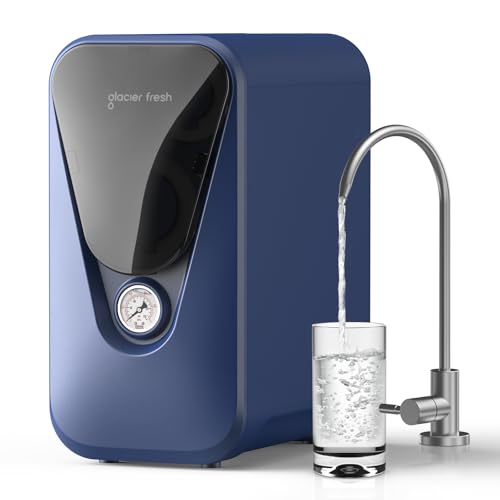
GLACIER FRESH GFU03 RO System
What We Like
- No electricity needed
- Near-silent operation
- 3:1 pure-to-drain ratio
- Built-in water pressure gauge
Trade-offs
- Requires drilling a 1/2"-1" hole in sink
- Minimum 40 PSI inlet pressure needed
If your under-sink cabinet has no outlet nearby, the Glacier Fresh GFU03’s water-powered design means you can still enjoy reverse osmosis without running an extension cord. Its 800 GPD flow keeps up with a busy household, and the built-in pressure gauge lets you monitor performance at a glance. This system is ideal for anyone who wants clean water without the hum of a pump or the hassle of an external tank, just set it and forget it.
You’ll need to drill a hole in your sink for the faucet, and if your home’s water pressure dips below 40 PSI, the flow will slow down noticeably. Compared to the Waterdrop G3P600, which relies on electricity, the GFU03 trades a bit of convenience (no outlet required) for a more demanding installation. For those with decent water pressure and a willingness to drill, it’s a quiet, efficient way to get great water without plugging in.
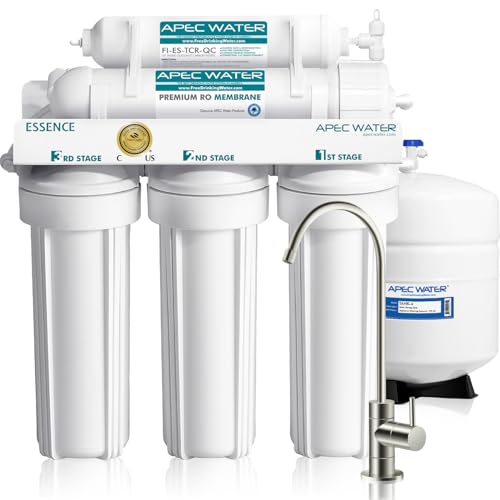
APEC Water ROES-50 RO System
What We Like
- 5-stage filtration removes 1000+ impurities
- NSF/ANSI 58 certified for safety
- DIY-friendly quick-connect fittings
- Includes faucet, tank, and installation kit
Trade-offs
- 50 GPD output is slower than tankless models
- Bulky tank takes up under-sink space
- Filter replacement every 6-24 months
A 50 GPD output means this system produces about two gallons of purified water per hour, which is plenty for drinking and cooking in most households. The five-stage filtration tackles arsenic, lead, fluoride, chlorine, and over a thousand other contaminants, so you get crisp, clean water straight from the tap. It comes with everything you need to get started, brushed nickel faucet, storage tank, and a full set of filters, and the quick-connect fittings make installation straightforward for a confident DIYer. For anyone wanting reliable reverse osmosis without a high upfront cost, this system delivers proven performance.
The trade-off for that low upfront cost is speed. At 50 GPD, it fills a glass more slowly than many tankless models, and the included storage tank takes up a fair amount of cabinet real estate. So you will want to measure your under-sink space before buying. Filters need swapping every six to 24 months depending on your water quality, but the process is simple and the long filter life keeps maintenance minimal. For a no-fuss RO system that does the job without extra bells and whistles, this is a solid value.
Product photos
Express Water ROALK5D 10-Stage RO System

What We Like
- 10-stage filtration with alkaline minerals
- Adds calcium, potassium, and magnesium
- Easy DIY installation under sink
Trade-offs
- 50 GPD output is slow for heavy use
- Large tank requires extra cabinet space
A 10-stage filtration system that adds calcium, potassium, and magnesium back into your water means you get crisp, mineral-rich drinking water straight from the tap. The Express Water ROALK5D is built for anyone who wants more than just pure water, it’s designed to improve taste and provide essential electrolytes. With a 50 GPD output, it’s best suited for smaller households or those who don’t mind waiting for the tank to refill. The system includes a chrome faucet and leak detection, and it carries NSF 372 certification for lead-free materials. If you value enhanced flavor and mineral content over raw speed, this system delivers exactly that.
At 50 gallons per day, this system is noticeably slower than tankless options like the Waterdrop G3P600, which delivers 600 GPD, and its large storage tank takes up considerable under-sink space. On the plus side, the 10-stage process includes an alkaline filter that adds calcium, potassium, and magnesium to your water, so you get mineral-enhanced water straight from the tap. Just be prepared for the slower pace and the physical footprint, it’s a practical choice if you value those added minerals and don’t mind the wait.
Product photos
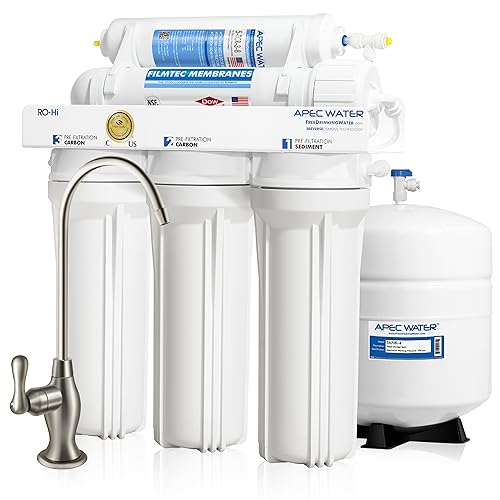
APEC Water RO-Hi Fast Flow RO System
What We Like
- USA-made filters for long life
- 3/8" fast-flow output for quick dispensing
- Reduces 99% of impurities including lead
- Lifetime support from certified specialists
Trade-offs
- Tank-based design takes up under-sink room
- 5.2-inch height limits shallow cabinet fit
The 3/8-inch fast-flow output on this APEC system increases the flow rate of water from tank to faucet, so you can fill a glass or pitcher faster than with a standard output. That cuts down wait time when drawing water for soups or beverages. Built with USA-made filters and designed, engineered, and assembled in the USA, the system is meant to last. Its five-stage process reduces impurities including chlorine, taste, odor, VOCs, fluoride, arsenic, lead, heavy metals, and over 1,000 other contaminants, delivering clean water without the need for bottled water.
The trade-off is a traditional tank design, which takes up under-sink space. At 25 pounds and with a 5.2-inch height, it may not fit every cabinet. But if you have the room and want a system with a higher water flow for filling pots, this APEC model offers a durable build and lifetime support from WQA-certified specialists.
Product photos
How We Evaluated Under Sink Reverse Osmosis Systems
Our research began with a thorough review of manufacturer specifications and NSF/ANSI certification listings. We cross-referenced each system’s claimed performance against its certifications for TDS reduction, contaminant removal, and material safety. Owner feedback patterns across thousands of reviews helped us understand real-world installation ease, filter longevity, and common issues.
We prioritized four criteria for this category. Certified filtration ensures the system actually removes what it claims. Flow rate determines how quickly you can fill a glass or pot. Water efficiency matters for both environmental impact and utility costs. Installation requirements affect whether the system fits your under-sink space and electrical setup.
An evaluation based on research cannot replace the experience of daily use. We rely on documented specifications, third-party certifications, and consistent owner reports to identify strengths and trade-offs. This approach gives you a reliable starting point, but your specific kitchen layout and water quality should guide your final choice.
What To Look For In Under Sink Reverse Osmosis Systems
The best under sink RO system for your home balances certified filtration, flow rate, water efficiency, and fit. Understanding these factors helps you avoid a system that is too slow, too wasteful, or too large for your cabinet.
Look for NSF/ANSI 58 certification for TDS reduction, a flow rate that matches your household size, a low pure-to-drain ratio to save water, and a design that fits your under-sink space and electrical access.
Certification and Filtration Stages
NSF/ANSI 58 certification is the gold standard for reverse osmosis systems, confirming the unit effectively reduces total dissolved solids. Some systems also carry NSF/ANSI 42 for aesthetic effects like chlorine taste and odor, or NSF/ANSI 53 for health-related contaminant reduction. Filtration stages range from 5 to 10, with additional stages often adding alkaline minerals or UV sterilization. More stages can mean better water quality but also higher filter replacement costs.
Flow Rate and Tank vs. Tankless Design
Flow rate, measured in gallons per day (GPD), determines how fast water dispenses. Tankless systems like the Waterdrop G3P600 deliver 600 GPD or more, filling a cup in seconds. Tank-based systems typically offer 50 GPD but store purified water in a tank, providing a reserve for quick dispensing. Tankless designs save cabinet space but require an electrical outlet, while tank systems work without power but take up under-sink storage.
Water Efficiency and Pure-to-Drain Ratio
The pure-to-drain ratio shows how much wastewater the system produces for every gallon of purified water. A 1:1 ratio means one gallon of wastewater per gallon of pure water, while a 3:1 ratio is much more efficient. Look for systems with at least a 1:1 ratio, though 2:1 or 3:1 models save significantly more water over time. Higher efficiency also reduces your water bill.
Installation and Space Requirements
Under-sink RO systems vary in footprint and installation complexity. Tankless units are compact but need a nearby electrical outlet and a dedicated faucet hole. Tank-based systems require more cabinet space for the storage tank. Some models need drilling for the faucet, while others use existing sink holes. Check your under-sink dimensions and electrical access before purchasing.
- Measure your under-sink cabinet height, width, and depth before choosing a system
- Confirm you have an available electrical outlet if selecting a tankless model
- Check if your sink has an extra hole for the RO faucet or if drilling is needed
- Verify your water pressure meets the system’s minimum requirement, especially for non-electric models
- Review filter replacement costs and frequency to estimate long-term expenses
A system that fits your space and electrical setup will save you installation headaches and return visits to the hardware store.
Under Sink Reverse Osmosis Systems Compared
The table below compares all ten under sink reverse osmosis systems across key specifications, including flow rate, certification, water efficiency, and installation requirements.
| Product | Filtration Stages | Flow Rate | Dimensions |
|---|---|---|---|
| Waterdrop G3P600 Tankless RO System | 8-stage | 600 GPD | 18.1 x 5.7 x 17.8 in |
| Waterdrop G3P800-WCK RO System | 10-Stage | 800 GPD | 18.1 x 5.7 x 17.7 in |
| iSpring RO500AK Alkaline RO System | Alkaline remineralization | 500 GPD | 17.5 x 5.2 x 16.2 in |
| Philips Aquaporin RO System | N/A | 600 GPD | 15.8 x 4.3 x 12.3 in |
| iSpring RO1200AK Dual-Flow RO System | 4-stage + alkaline | 1200 GPD | 17 x 14 x 6 in |
| VIOMI V8 PRO RO System | 9-Stage | 800 GPD | 16.3 x 5.0 x 12.8 in |
| GLACIER FRESH GFU03 RO System | 7-stage | 800 GPD | 13.6 x 8.3 x 16.5 in |
| APEC Water ROES-50 RO System | 5-Stage | 50 GPD | 15.5 x 5.2 x 17.0 in |
| Express Water ROALK5D 10-Stage RO System | 10-stage | 50 GPD | 19.0 x 18.0 x 19.0 in |
| APEC Water RO-Hi Fast Flow RO System | 5-Stage | Fast Flow 3/8" Output | 16 x 17.5 x 5.2 in |
Frequently Asked Questions
What is the difference between tankless and tank-based RO systems?
Tankless systems filter water on demand and do not store it, saving under-sink space and providing continuous flow. They require an electrical outlet to operate. Tank-based systems store purified water in a tank, offering a reserve for quick dispensing without electricity, but the tank takes up significant cabinet space.
How often do I need to replace the filters on an under sink RO system?
Filter replacement schedules vary by model and water usage. Most systems require sediment and carbon filter changes every 6 to 12 months, while the RO membrane typically lasts 2 to 3 years. Some systems have indicator lights or smart faucets that remind you when to change filters.
Do I need an electrician to install an under sink RO system?
Most under sink RO systems use standard plumbing connections and do not require an electrician for the water lines. However, tankless models need a nearby electrical outlet. If your under-sink area lacks one, you may need an electrician to install an outlet. Non-electric models avoid this requirement entirely.
Will an under sink RO system fit in my small cabinet?
Many tankless models are compact enough for small cabinets, but you should measure your space first. Tank-based systems require room for both the filter unit and the storage tank. Check the dimensions of any system against your cabinet’s height, width, and depth, including clearance for the shut-off valve and tubing.
How much wastewater do reverse osmosis systems produce?
Wastewater production varies by model. Older or less efficient systems may produce 3 to 4 gallons of wastewater for every gallon of purified water. Modern efficient systems achieve ratios of 1:1, 2:1, or even 3:1 pure-to-drain, meaning less wastewater. Look for the pure-to-drain ratio to compare efficiency.
The Bottom Line
The Waterdrop G3P600 Tankless RO System is our best overall pick for homeowners who want certified filtration, a space-saving tankless design, and real-time water quality feedback from a smart faucet. Its 2:1 low drain ratio saves water, and tool-free filter changes make maintenance simple. If your under-sink cabinet lacks an electrical outlet, the non-electric GLACIER FRESH GFU03 is a strong alternative.
For busy families needing faster flow, the Waterdrop G3P800-WCK delivers 800 GPD with a 3:1 pure-to-drain ratio. Budget-conscious buyers should consider the APEC Water ROES-50, a proven NSF-certified system with straightforward installation, though it uses a storage tank and has a slower 50 GPD output.
The single most important factor in choosing an under sink RO system is matching the design to your cabinet space and electrical access. Measure first, check your water pressure, and confirm certification levels. The right system will deliver clean, great-tasting water for years with minimal hassle.
