10 Best Low Voltage Transformers For Landscape Lighting 2026
This post contains affiliate links. As an Amazon Associate, we earn from qualifying purchases.
For most homeowners, the WILAWELS 300W Dual Zone Landscape Transformer is the best overall choice because it offers independent control over two separate lighting zones with five flexible modes. If you prefer a simpler automated setup, the DEWENWILS 300W is a strong pick for timer and sensor combo, while the SUNVIE 300W Weatherproof model is built to withstand the elements.
Choosing the right transformer for your landscape lighting is about matching power output to your fixture count and deciding how much control you want over scheduling. Too small a unit and your lights will be dim; too large and you waste capacity. The real question is whether you need separate timers for your front walkway and backyard path.
This guide is based on a thorough review of manufacturer specifications, expert recommendations, and patterns in owner feedback across dozens of models. We have organized ten of the best options by their specific strengths to help you find the right fit for your yard.
Top 10 Low Voltage Transformers For Landscape Lighting in the Market
Certain content that appears on this site comes from Amazon. This content is provided "as is" and is subject to change or removal at any time.
The Best Low Voltage Transformers For Landscape Lighting, Reviewed
WILAWELS 300W Dual Zone Landscape Transformer

What We Like
- Dual-zone independent control
- 5 lighting modes for flexibility
- Detachable photocell sensor
- Memory function retains last mode
Trade-offs
- Total load limited to 80% of rated power
- Two zones share a single 80% power cap
With two independently controlled output zones, this 300W transformer lets you manage different areas of your landscape lighting separately, front path lights on a timer while backyard uplights stay on all night. That dual-zone flexibility is the standout feature here, giving you real customization without needing a second unit. It also offers five modes including countdown and dusk-on timer-off, so you can dial in exactly how long each zone runs. The detachable photocell sensor with a six-foot cord makes placement easy, and the memory function remembers your last settings after a power outage.
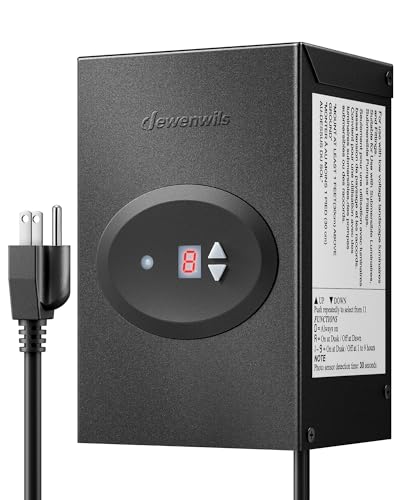
DEWENWILS 300W Landscape Transformer
What We Like
- Built-in dusk-to-dawn photocell sensor
- 1-9 hour countdown timer for auto shutoff
- Memory function retains mode after power outage
- Weatherproof metal housing for outdoor use
Trade-offs
- Memory function requires 24 hours of run time before it works
- Single zone output limits independent light grouping
A built-in dusk-to-dawn sensor and a 1-9 hour countdown timer let you set landscape lights to turn on at sunset and shut off after a chosen number of hours without touching the unit again. That combination is rare in a single transformer, and the memory function keeps your settings even after a power outage, so you don’t have to reprogram it every time the weather knocks out electricity. This makes the DEWENWILS 300W a strong fit for homeowners who want true set-and-forget lighting control with a programmable timer.
The trade-off is weight and flexibility. More importantly, the DEWENWILS has a single output zone, so all connected lights turn on and off together. For straightforward setups where one timer covers everything, this transformer delivers reliable, automated control without daily fuss.
SUNVIE 300W Weatherproof Landscape Transformer

What We Like
- Dusk-to-dawn photocell sensor
- Overload protection with memory function
- Weatherproof and corrosion-resistant build
- 5 setting modes for flexibility
Trade-offs
- At 11.2 lb, heavier than some competitors
- Single zone limits independent circuit control
A 300W capacity with weatherproof construction means this transformer can handle a sizable landscape lighting setup while standing up to rain, snow, and dust year after year. The automatic photocell sensor turns lights on at sunset and off at sunrise, so you don’t have to think about it. With five setting modes, including manual, automatic, photocell plus timer, and test mode, you get plenty of control to match your routine and save energy. The overload protection and memory function add peace of mind: if the circuit trips, it resets and remembers your last mode, so you don’t have to reprogram everything after the power comes back.
This is a single-zone transformer, so all connected lights run on the same schedule and brightness. If you want to control different areas independently, say, path lights on one timer and spotlights on another, you’d need a dual-zone model like the SUNVIE 300W Dual Zone Landscape Transformer. At 11.2 pounds and roughly 7.9 inches long, it’s also heavier and bulkier than some alternatives, so make sure your mounting spot has solid support. For straightforward, weatherproof performance with reliable automatic operation, this is a strong choice for homeowners who want set-and-forget convenience.
SUNVIE 300W Dual Zone Landscape Transformer

What We Like
- Two independently controlled output zones
- Removable external photocell with 6.8ft cord
- Five versatile setting modes
- Built-in circuit protection with memory function
Trade-offs
- Total load per zone limited to 80% of rated power
- At 8.8 inches long, takes up more space than some compact models
With two independent control zones, this 300W transformer lets you run your pathway lights on a dusk-to-dawn schedule while your spotlights follow a countdown timer, all from one unit. That dual-zone flexibility makes it ideal for larger yards where different areas need different lighting moods. The external photocell sensor comes on a 6.8-foot cord, so you can place the sensor in direct sunlight while the transformer stays sheltered under an eave or inside a garage. Five modes (manual, auto, countdown, timer, and photocell-on-timer-off) give you plenty of scheduling options without needing a separate smart controller.
Each zone’s load must stay within 80% of the transformer’s total 300W rating, so you’ll need to plan your fixture wattage carefully if you’re maxing out both zones. The SUNVIE’s dual-zone design adds real convenience for complex layouts compared to single-zone models. For homeowners who want zone-level control without stepping up to a smart system, this is a practical, weatherproof solution.
DEWENWILS 120W Landscape Transformer
What We Like
- Built-in dusk to dawn sensor
- Countdown timer from 1 to 9 hours
- Memory function retains settings after power loss
- Weatherproof metal construction
Trade-offs
- 120W capacity limits larger lighting setups
- No dual-zone control for separate areas
A 120W output means this transformer handles a modest set of pathway lights or a handful of spotlights without overloading, and the integrated photocell sensor takes the guesswork out of scheduling. For someone with a small to medium yard who wants simple, reliable automation, the DEWENWILS 120W delivers exactly that. The 1-9 hour countdown timer lets you decide how long the lights stay on after sunset, and the memory function keeps your chosen mode after a power cut. Its compact metal body mounts directly to an outdoor wall and resists weather, so you can set it and forget it.
A 120W output won’t stretch far if you plan to light a large property or run many fixtures. Compared to the WILAWELS 300W Dual Zone, this model lacks separate output zones, meaning all connected lights turn on and off together. Still, for a focused, low-maintenance setup that doesn’t need extra complexity, this compact unit is a practical choice.
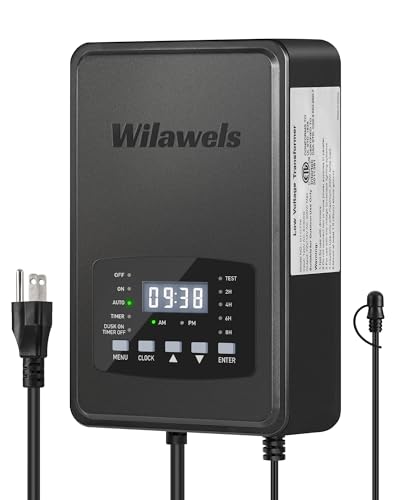
WILAWELS 200W Landscape Transformer
What We Like
- Six versatile setting modes
- Detachable dusk-to-dawn photocell sensor
- Built-in circuit protection
- Memory function retains settings
Trade-offs
- Only 200W capacity limits larger setups
- Sensor cord only 6ft long
- Outdoor installation only
Six setting modes give you control over landscape lighting, from manual on/off to dusk-to-dawn automation, countdown timers, and a DUSK ON TIMER OFF option. The detachable photocell sensor makes the auto modes set-and-forget, while built-in circuit protection and a memory function keep it running smoothly after a power interruption. This transformer suits homeowners who want multiple scheduling options without needing extra devices.
The 200W capacity means it supports a moderate number of lights; if you need more power, consider higher-wattage models. The sensor cord is 6 feet long, which may limit placement options. For those who prioritize scheduling versatility, the WILAWELS offers six modes that cover a range of lighting needs.
Product photos
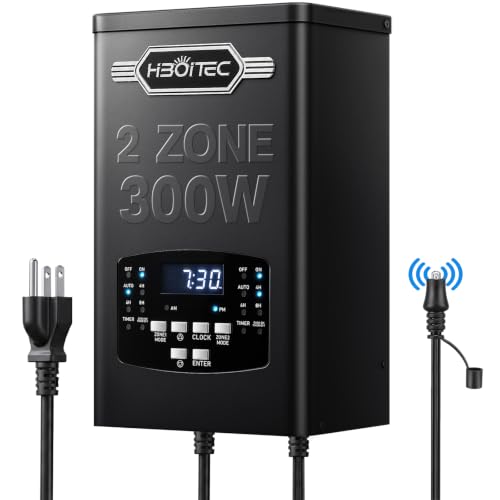
HIBOITEC 300W Dual Zone Transformer
What We Like
- Two fully independent timer zones
- IP65-rated weatherproof sensor probe
- 5 timer modes with auto memory
- 10-year free replacement warranty
Trade-offs
- Main unit best mounted indoors or in garage
- 300W capacity supports up to 30 LED fixtures
Two fully independent timer zones set this transformer apart from most dual-zone models, which share a single timer across both outputs. With HIBOITEC, you can run your front yard path lights on an automatic dusk-to-dawn schedule while your backyard spotlights turn on at 7 PM and shut off at midnight, each zone operates completely on its own terms. Five timer modes, including a photocell-plus-timer combo, give you precise control, and the auto memory restores your settings after any power interruption. This is the transformer for homeowners who want separate schedules for different areas of their landscape.
That means you need a dry, accessible spot near an outlet, not always convenient if your garage is far from the yard. But if you have a garage or basement wall near your landscape wiring, the independent zone control and 10-year replacement warranty make it a worthwhile choice for anyone serious about customizing their outdoor lighting.
Product photos
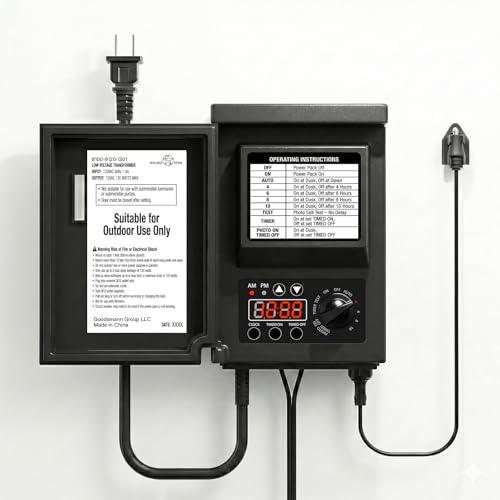
GOLDEN STAR 120W Outdoor Transformer
What We Like
- 5 smart timer and photocell modes
- Detachable photocell for accurate light sensing
- Weather shield front cover
- Memory restores settings after power loss
Trade-offs
- 120W limits to smaller lighting layouts
- No dual-zone output for separate areas
The detachable photocell can be placed away from shaded walls or covered corners, so the transformer responds more naturally to outdoor light changes. With five smart modes including dusk-to-dawn, countdown timers, and photo-on-timed-off, you can tailor the schedule to pathways, patios, or trees without fiddling every night. The weather shield cover protects the display and wiring from rain and debris while keeping controls easy to reach, and the memory function restores your last setting after a power interruption. This 120W unit is built for smaller low-voltage landscape lighting setups, converting household power for path lights, spotlights, garden lights and other 12V AC fixtures.
At 120W, this transformer powers a handful of LED path lights or a few spotlights, so it’s best for a focused garden or front walk rather than a large yard with multiple zones. The WILAWELS 300W Dual Zone Transformer has two independent outputs, which could work better if you need separate schedules for different areas. With a single output, all connected lights run on the same timer or photocell setting. Its compact size, 3.8 inches wide and 7.1 inches tall, lets it fit into tight spaces, making it a practical pick for smaller lighting projects.
Product photos
Malibu 120W Power Pack Transformer

What We Like
- Five versatile operating modes
- Detachable photocell sensor
- Built-in circuit protection with memory
- Weather-resistant plastic construction
Trade-offs
- 120W max load limits larger installations
- Weighs 6.5 lb, heavier than some similar models
Five distinct operating modes give you real control over your landscape lighting schedule, from simple manual on/off to dusk-to-dawn sensing and countdown timers that run 4, 6, 8, or 10 hours. That flexibility makes this Malibu transformer ideal for homeowners who want to fine-tune their outdoor lighting without needing a smart hub. The detachable photocell sensor simplifies setup, and the built-in circuit protection automatically cuts power during overloads, with a memory function that recalls your last mode after the power comes back. At 120W, it handles a moderate number of fixtures, and the weather-resistant plastic body stands up to rain and sun.
A 120W limit restricts how many lights you can run at once, especially if you’re using higher-wattage fixtures or have a large yard. The Malibu weighs 6.5 pounds, which is about a pound more than the DEWENWILS 120W model, so plan for a sturdy mounting surface. Still, for a mid-sized garden or pathway setup where you want scheduling options without complexity, this transformer delivers reliable performance and straightforward operation.
Product photos
onlyfire 60W Waterproof Transformer
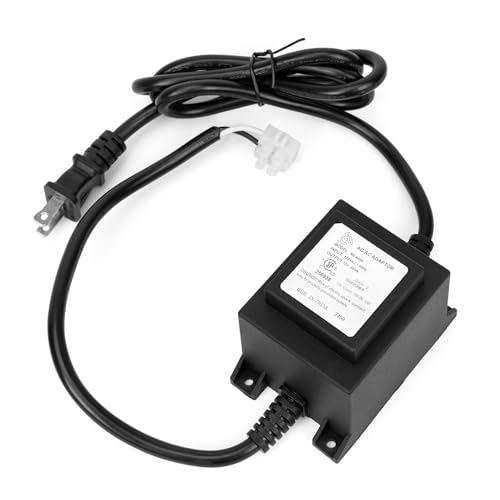
What We Like
- Molded weatherproof body for outdoor use
- Built-in hanging hole for easy wall mounting
- Converts 110-120V to safe 12V AC
- Ideal for small landscape lighting setups
Trade-offs
- Only 60W capacity limits larger installations
- Output is AC, not DC (check before ordering)
- No timer or photocell sensor included
At just 60 watts, this transformer is designed for small, focused lighting projects rather than whole-yard systems. Its molded weatherproof body and built-in hanging hole make it a straightforward, no-fuss option for mounting directly on an outdoor wall, protecting it from rain, snow, and dust. For someone who needs to power a few pathway lights or a single garden spotlight without extra features, this is a compact, basic solution that gets the job done simply.
You won’t find any timer or photocell sensor here, so you’ll need to plug and unplug manually or add your own controller. If you prefer a no-frills, waterproof transformer for a small, dedicated circuit and don’t mind the AC-only output, this is a reliable, space-saving pick.
Product photos
How We Evaluated Low Voltage Transformers For Landscape Lighting
To build this list, we started with the technical specifications from each manufacturer, wattage capacity, number of zones, timer modes, and weatherproofing ratings. We then compared those specs against expert round-ups from landscape lighting professionals and cross-referenced them with the most common praise and complaints found in owner feedback.
The four criteria that mattered most were wattage capacity, which means matching your total light fixture load. Zone control lets you run separate schedules for different areas. Timer and photocell flexibility determines how well the unit automates dusk-to-dawn operation. Build quality covers weatherproofing and durability for outdoor installation.
This evaluation is based on research. It relies on the consistency of manufacturer claims, expert consensus, and the real-world experiences shared by thousands of homeowners to identify which transformers perform as advertised.
What To Look For In Low Voltage Transformers For Landscape Lighting
The right transformer keeps your lights bright and your schedule simple. Focus on wattage, zone control, and automation features first.
Choose a transformer with a wattage rating at least 20% higher than your total light load. Decide if you need independent zones. Then look for a dusk-to-dawn sensor or countdown timer that fits your daily routine.
Wattage Capacity and Load Planning
Every low voltage transformer has a maximum wattage rating, but you should never run it at full capacity. A good rule is to keep your total light load at 80% of the transformer’s rated wattage. For example, a 300W transformer can comfortably handle about 240W of lighting fixtures. This buffer prevents overheating and extends the life of the unit. Count the wattage of every fixture you plan to connect before you buy.
Zone Control: Single vs. Dual
A single-zone transformer powers all connected lights on the same schedule, they turn on and off together. Dual-zone models let you run two independent schedules, which is ideal if you want path lights on all night but accent trees on a shorter timer. If your landscape has distinct areas like a front walkway and a backyard patio, dual-zone control is worth the extra cost.
Automation Features: Timers and Photocells
- A built-in dusk-to-dawn photocell turns lights on at sunset and off at sunrise automatically.
- A countdown timer lets you set lights to run for 1 to 9 hours after dusk.
- Memory function saves your settings so the transformer remembers them after a power outage.
- Detachable photocells (with a cord) let you place the sensor away from the transformer for more accurate light detection.
For most homeowners, a transformer with both a dusk-to-dawn sensor and a programmable countdown timer offers the best balance of convenience and control.
Low Voltage Transformers For Landscape Lighting Compared
The table below compares each transformer’s wattage, zone configuration, and key automation features side by side.
| Product | Wattage | Output Voltage | Modes |
|---|---|---|---|
| WILAWELS 300W Dual Zone Landscape Transformer | 300W | 12/14V AC | 5 modes |
| DEWENWILS 300W Landscape Transformer | 300W | 12V/14V AC | N/A |
| SUNVIE 300W Weatherproof Landscape Transformer | 300W | 12V/14V AC | 5 modes |
| SUNVIE 300W Dual Zone Landscape Transformer | 300W | 12/14V AC | 5 setting modes |
| DEWENWILS 120W Landscape Transformer | 120W | 12V AC | N/A |
| WILAWELS 200W Landscape Transformer | 200W | 12/14V AC | 6 setting modes |
| HIBOITEC 300W Dual Zone Transformer | 300W | 12V/14V AC | 5 modes |
| GOLDEN STAR 120W Outdoor Transformer | 120W | 12V to 12V AC | 5 modes |
| Malibu 120W Power Pack Transformer | 120W | 12V Output | N/A |
| onlyfire 60W Waterproof Transformer | 60 W | 12V AC | N/A |
Frequently Asked Questions
What size low voltage transformer do I need for my landscape lights?
Add up the total wattage of every light fixture you plan to connect, then choose a transformer rated at least 20% higher than that total. For example, if your lights add up to 200 watts, a 300W transformer gives you a safe buffer and room to add a few more fixtures later.
Can I use a low voltage transformer indoors?
Most landscape transformers are designed for outdoor installation, but some models like the HIBOITEC 300W Dual Zone are best mounted indoors or in a garage. Always check the manufacturer’s installation instructions. If you mount an outdoor-rated unit outside, make sure it is protected from direct rain and placed above ground level.
What is the difference between single zone and dual zone transformers?
A single zone transformer runs all connected lights on the same schedule. A dual zone transformer has two independently controlled outputs, letting you set different on/off times for separate groups of lights. Dual zone is useful when you want pathway lights on all night but garden accent lights on a shorter timer.
Do I need a transformer with a dusk-to-dawn sensor?
A dusk-to-dawn sensor automates your lights so they turn on at sunset and off at sunrise without a timer. It is convenient for security and curb appeal, but not required if you prefer a simple countdown timer or manual control. Many transformers offer both options.
How long do low voltage landscape transformers last?
With proper installation and a load kept at 80% of the rated capacity, a quality transformer can last 5 to 10 years. Weatherproof metal housings and built-in circuit protection help extend the lifespan. Exposure to direct rain and extreme temperatures can shorten it, so mounting the unit in a sheltered location is best.
The Bottom Line
For most homeowners, the WILAWELS 300W Dual Zone Landscape Transformer offers the best combination of power, flexibility, and independent zone control. It is the right choice if you want separate schedules for different parts of your yard and appreciate having five lighting modes to choose from.
If your landscape is smaller or you prefer a simpler automated setup, the DEWENWILS 300W is an excellent timer and sensor combo that handles dusk-to-dawn operation without the complexity of dual zones. For those who need a rugged outdoor unit that can take the weather, the SUNVIE 300W Weatherproof model is built to last.
The single most important factor when buying a landscape transformer is matching its wattage capacity to your total light load with a 20% safety buffer. Get that right, and the rest is about choosing the automation features that fit your daily routine.
