10 Best Benchtop Planers in 2026
This post contains affiliate links. As an Amazon Associate, we earn from qualifying purchases.
For most woodworkers, the DEWALT DW735X Thickness Planer is the best benchtop planer because it combines a powerful 15 amp motor with a two-speed gearbox and a fan-assisted chip ejection system that keeps work moving. If you prioritize a silky-smooth finish, the DEWALT DW734 delivers 96 cuts per inch, while the JET JWP-13BTHH offers a helical cutterhead for quieter operation and longer-lasting carbide inserts.
Choosing a benchtop planer means balancing motor power, cutterhead type, and weight against the space you have and the stock you plane most often. A planer that handles wide boards and dense hardwoods might be too heavy to move between job sites, while a lightweight portable model may struggle with thick stock.
This guide is built from manufacturer specifications, expert round-ups, and patterns in owner feedback across ten models. We break down what matters most so you can match a planer to your shop and your projects.
Top 10 Benchtop Planers in the Market
Certain content that appears on this site comes from Amazon. This content is provided "as is" and is subject to change or removal at any time.
The Best Benchtop Planers, Reviewed
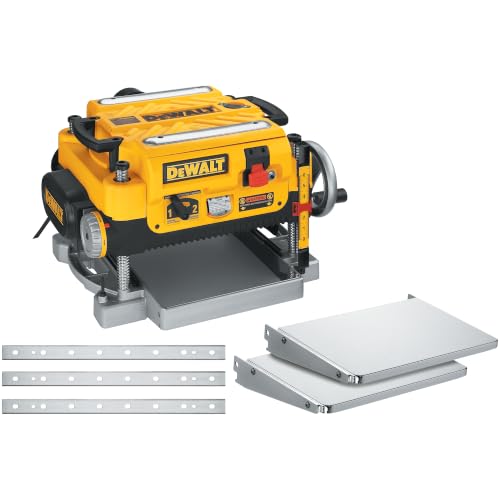
DEWALT DW735X Thickness Planer
What We Like
- Powerful 15 amp motor
- Two-speed gearbox for feed control
- Fan-assisted chip ejection
- Automatic carriage lock reduces snipe
Trade-offs
- At 102 pounds, requires a sturdy stand
- Three knife cutterhead, not helical carbide
The 15 amp motor and 20,000 rpm cutterhead speed handle larger cuts in wider materials with ease, so you can work on bigger boards without the planer struggling. The two-speed gearbox lets you choose between 96 or 179 cuts per inch, giving you flexibility depending on the wood and finish you want. Fan-assisted chip ejection clears debris from the cutterhead and exhausts it out of the machine, keeping your workspace cleaner. The automatic carriage lock reduces snipe without you having to engage it manually, which is a convenience for consistent results.
The trade-off is weight: at 102 pounds, it’s substantially heavier than the DEWALT DW734 (80 pounds) and definitely not something you’ll move around the shop casually. You’ll want a dedicated stand or bench.
DEWALT DW734 Benchtop Planer

What We Like
- 96 cuts per inch for fine finish
- Disposable reversible knives extend life
- Four-column carriage lock reduces snipe
- Extra-long tables support long boards
Trade-offs
- 80 lb weight requires sturdy stand
- 12-1/2 inch width limits wide stock
The three-knife cutter head on this planer spins at 10,000 rpm to deliver 96 cuts per inch, which means you get a very smooth finish straight off the machine, ideal for furniture builders and trim carpenters who want to minimize sanding. The four-column carriage lock keeps the head stable, which drastically reduces snipe at the ends of boards. The extra-long infeed and outfeed tables provide 33-1/2 inches of support so long stock doesn’t wobble during passes. Disposable reversible knives let you flip or replace blades in minutes without sharpening, saving time and keeping cuts consistent.
The trade-off is weight: at 80 pounds, this planer is heavy enough that you’ll want a dedicated stand or a sturdy workbench, it’s not something you’ll casually move around the shop. The 12-1/2-inch width also means you can’t plane a full 13-inch board in one pass, unlike the JET JWP-13BTHH. But if your work stays within that width and you prioritize a silky finish over portability or extra capacity, the DW734 delivers on its promise. It’s a focused tool for fine woodworking, not a do-everything machine.
JET JWP-13BTHH Benchtop Planer

What We Like
- 30 four-sided carbide inserts
- Rotate inserts for fresh edges
- 5 spare inserts included
Trade-offs
- Requires a 20A dedicated circuit
- Not for plywood or reclaimed lumber
- 66 lb needs two people to unbox
A helical cutterhead with 30 four-sided carbide inserts means you get a smoother finish and quieter operation, 91 dB vs. 93 dB on JET’s own straight-knife version, without swapping full knife sets. When one edge dulls, just rotate the insert 90 degrees to a fresh edge, and five spares are included to keep you planing longer. This planer is built for serious hobbyists and small-shop woodworkers who work with solid hardwood or softwood up to 13 inches wide and 6 inches thick. A 2 HP motor takes up to 1/8 inch per pass on narrower boards. The four-post head support and fine-increment dial give you controlled height adjustments, and the depth stop lets you return to common thicknesses quickly.
This machine demands a 20A dedicated circuit, so you can’t just plug it into any outlet in a garage or basement shop. At 66 pounds, it’s heavy enough that you’ll want a second person to help unbox it, and it’s not designed for plywood, painted lumber, or reclaimed stock, only solid wood. For a shop focused on fine furniture or cabinetry with solid wood, the JET’s helical cutterhead and easy insert rotation make it a long-term value.
Cutech 40800H Spiral Planer

What We Like
- Spiral cutterhead with 26 carbide inserts
- Two-sided inserts for extended life
- Snipe minimizer with 4 lead screws
- 2-speed feed for figured wood
Trade-offs
- Dust collection requires separate hose
- Two-speed feed requires manual adjustment
A spiral cutterhead with 26 tungsten carbide inserts is the feature that sets this planter apart. It delivers a noticeably smoother finish than straight-knife designs while running quieter, which matters when you’re working in a home shop or garage. The two-sided inserts also last longer before needing replacement, so you spend less time swapping blades and more time planing. For someone stepping up from a basic benchtop model, this is a smart upgrade that brings professional results without the frustration of tear-out or frequent knife changes.
The 2-speed feed helps with figured wood, and the flip dust hood can be set to blow chips out the back or attach to a dust collector for collection. The snipe minimizer uses four lead screws and a patented coupling to reduce snipe automatically. If you want a spiral cutterhead with carbide inserts and snipe-minimizing hardware, this planer delivers those features.
JET JWP-13BT Benchtop Planer

What We Like
- Helical cutterhead for quieter cuts
- 26 quick-change HSS inserts
- 2-speed feed for different stock
- Cast iron bed reduces snipe
Trade-offs
- 75 lbs makes it less portable
- Requires a 20A dedicated circuit
- HSS inserts dull faster than carbide
The helical-style cutterhead with 26 individual HSS inserts is the standout feature here, delivering noticeably quieter operation than traditional straight-knife planers. That makes this Jet a strong choice for anyone working in a shared shop or a home garage where noise matters. The 2-speed feed lets you choose between a slower, finer finish or faster stock removal, and the precision-machined cast iron bed helps keep boards flat while reducing snipe. With a 13-inch width and 6-inch depth capacity, it handles most common dimensional lumber without issue, and the four-post design adds stability during deeper passes.
Compared to the lighter JET JWP-13BTHH (66 lbs), this model uses HSS inserts instead of carbide, so the blades will need replacing sooner with heavy use. Still, for a woodworker who prioritizes a calm workspace and is willing to give up some portability, the JWP-13BT delivers a refined planing experience without the roar.
WEN PL1326 Spiral Planer
What We Like
- Spiral cutterhead with 26 HSS blades
- Onboard material removal gauge
- Planes up to 6 inches thick
- 15A motor at 10,000 RPM
Trade-offs
- At 81 lb, it's heavy for a benchtop model
- HSS blades dull faster than carbide inserts
- Single feed rate limits versatility
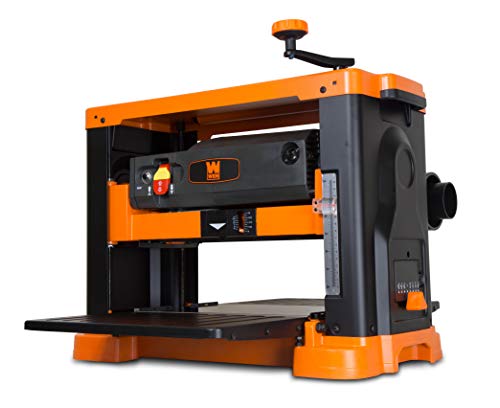
With a 15-amp motor spinning at 10,000 RPM and a 26-feet-per-minute feed rate, it handles boards up to 6 inches thick and 13 inches wide. The onboard material removal gauge takes the guesswork out of each pass.
The trade-off comes down to weight and blade longevity. At 81 pounds, it’s heavier than some benchtop models, so you’ll want a sturdy stand or bench rather than moving it around frequently. And while the HSS blades give a good finish, they won’t hold an edge as long as carbide inserts would, meaning more frequent replacements down the line. If you’re okay with a bit more heft and occasional blade swaps, this spiral planer offers spiral-cutting performance at a value that’s hard to beat.
Product photos
CRAFTSMAN CMEW320 Thickness Planer

What We Like
- 15 amp motor handles hard and soft wood
- Quick-change reversible knives for long life
- Vacuum port for dust collection
- 3 Year Limited Warranty
Trade-offs
- Two-knife cutterhead means fewer cuts per pass than three-knife models
- At 61.1 lb, it's heavy to move between jobsites
- 12.25-inch width limits wide boards compared to 13-inch planers
With 16,000 cuts per minute from a solid steel cutterhead, this planer powers through hard and soft wood without stalling, so you can take heavier passes on dense lumber. The 15-amp motor keeps the blades spinning under load, while the quick-change knife system lets you swap or flip blades in minutes rather than fighting with wrenches. A built-in dust port connects to your shop vac, and the 3-year warranty backs the tool if anything goes wrong.
The two-knife cutterhead is a compromise: it delivers fewer cuts per pass than three-knife models, which may affect finish speed. At 61.1 pounds, it’s a heavy machine that benefits from a sturdy stand. For a woodworker focused on getting consistent results, these are manageable compromises that keep the price accessible.
Product photos
WOODSTARTER 13-Inch Planer
What We Like
- 2000W motor handles thick stock
- Adjustable height up to 6-3/16"
- 3-in-1 dust port fits any vacuum
- Overload and overheat protection
Trade-offs
- At 52 lb, it's heavy to move
- HSS blades dull faster than carbide
- Single feed rate limits versatility
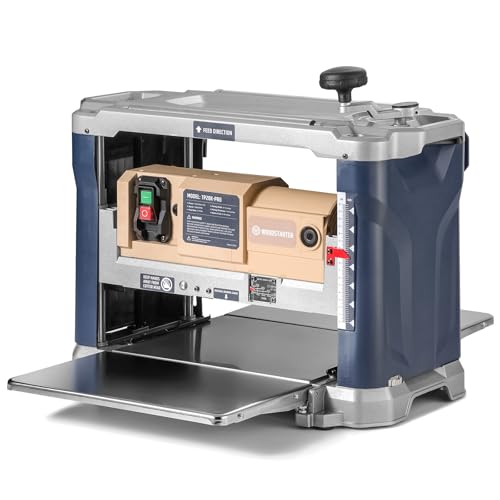
One thing to note is weight. At 52 pounds, it’s not something you’ll want to haul between job sites. The HSS blades deliver glass-smooth surfaces straight off the planer, but if you plan to run a lot of wood, the JET JWP-13BTHH offers a helical cutterhead with carbide inserts. For shop use where you value power and a clean finish, this planer delivers.
Product photos
Makita 2012NB Portable Planer

What We Like
- Compact and lightweight at 61.9 lb
- Fastest blade change system
- Stable 4-post design with cross supports
Trade-offs
- 12-inch capacity limits wider boards
- Heavy at 61.9 pounds for portability
At 61.9 pounds, this planer is light enough to carry to a jobsite or store on a shelf without a dedicated stand. Its compact footprint and large table extensions let you support long workpieces, while the 4-post design and diagonal cross supports keep everything steady during passes. The disposable double-edge blades swap quickly, and at 83 dB it’s the quietest planer in its class, so you can work without ear fatigue even on long sessions. This is the planer for the mobile woodworker who needs to move between sites or store tools away between projects.
The trade-off for that portability is a 12-inch cutting width, which means you can’t face-plane a 13-inch board in one pass like you could with the DEWALT DW735X’s 13-inch capacity. For the weekend carpenter or contractor who values easy transport and quick blade changes over maximum capacity, this trade-off is well worth it. If you routinely work with 13-inch material and have a workshop to leave a planer in place, the DEWALT DW735X’s extra inch and heavier build might suit you better.
Product photos
Einhell TC-SP 204/1 Planer
What We Like
- 204 mm planing width for wide boards
- 1500 W motor handles tough jobs
- Aluminum jointer table with tilting stop
- Zero voltage switch for safety
Trade-offs
- At 50.5 lb, it needs a sturdy stand
- Only 3 mm max removal per pass
- Two knives instead of helical cutterhead
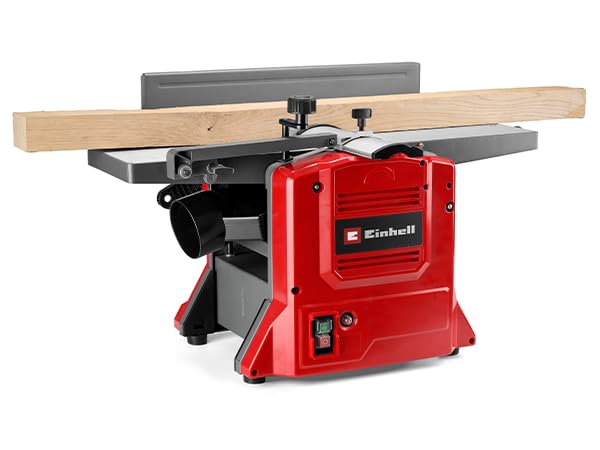
With a 204 mm planing width, this machine handles boards up to that width in a single pass, which is useful for furniture builders and joiners working with solid stock. The 1500 W motor keeps cuts consistent, while the aluminum jointer table with a tilting stop lets you square edges before thicknessing. The zero voltage switch prevents the machine from restarting after a power cut, adding safety. This stationary planer combines jointing and planing in one unit for the home shop.
At 50.5 pounds, the Einhell is heavy enough that you will need a dedicated stand or bench. The 3 mm maximum depth of cut means you take lighter passes on rough lumber, which slows down heavy stock removal. If you need faster material removal or a helical cutterhead, the JET JWP-13BTHH offers carbide inserts and a 2 HP motor, but at a higher weight and price. For the hobbyist who values versatility and safety, the Einhell delivers solid performance without breaking the bank.
Product photos
How We Evaluated Benchtop Planers
We reviewed each planer’s published specifications, motor amperage, cutterhead type, feed speed options, and maximum cut width and depth, then cross-referenced those details with expert round-ups and consistent themes in owner reviews. This evaluation is a synthesis of technical data and real-world user experience.
The four criteria that mattered most were cutterhead design (straight knife vs. Helical vs. Spiral), motor power for handling dense or thick stock, snipe control mechanisms, and overall weight and portability. A helical or spiral cutterhead produces a finer finish and runs quieter, but it costs more. A heavier planer with a cast-iron bed typically reduces snipe but is harder to move.
A research-led evaluation has limits: it cannot capture how a planer sounds under load after a year of use or how easily the infeed table adjusts when you are rushing through a project. We flag these trade-offs so you can decide which compromises fit your workflow.
What To Look For In Benchtop Planers
The right benchtop planer matches your motor needs, cutterhead preference, and workshop space. Focus on these three areas to narrow your choices quickly.
Choose a planer with at least a 15 amp motor for hardwoods, a helical or spiral cutterhead for quieter, smoother cuts, and a snipe-reduction system if you work with long boards.
Cutterhead Type and Finish Quality
Straight knife cutterheads are the most affordable and easy to sharpen, but they produce more tear-out on figured wood and are louder. Helical and spiral cutterheads use multiple small carbide or HSS inserts that rotate or index for fresh edges, delivering a finer finish and significantly less noise. The trade-off is a higher upfront cost and, for HSS inserts, faster dulling than carbide.
Motor Power and Feed Speed
A 15 amp motor is the standard for benchtop planers that handle hardwoods and wide boards. Some models offer a two-speed gearbox, a slower feed rate for figured or dense stock and a faster rate for softwoods and dimensioning. Single-speed planers are simpler but less versatile when you switch between species.
Snipe Control and Weight
Snipe, a deeper cut at the start or end of a board, is the most common frustration with benchtop planers. Look for models with automatic carriage locks, four-column supports, or cast-iron beds that reduce snipe. Heavier planers (75 pounds and up) tend to be more stable and produce less snipe, but they require a sturdy stand and are harder to move.
- Check the maximum planing width: 12 inches is common, but 13-inch models handle wider stock.
- Confirm the dust port size matches your shop vacuum or dust collector.
- Measure your bench or stand to ensure the planer’s footprint fits.
- Look for a material removal gauge if you need to track stock thickness precisely.
A planer that weighs over 70 pounds is best treated as a semi-permanent station rather than a portable tool.
Benchtop Planers Compared
The table below compares all ten benchtop planers side by side, so you can see motor power, cutterhead type, and key features at a glance.
| Product | Motor | Cutterhead | Weight | Max Width |
|---|---|---|---|---|
| DEWALT DW735X Thickness Planer | 15 amp, 20000 rpm | Three knife | 102.0 pounds | 13-inch |
| DEWALT DW734 Benchtop Planer | 15 Amp, 20,000 rpm | 3-knife, 10,000 rpm | 80 pounds | 12-1/2-Inch |
| JET JWP-13BTHH Benchtop Planer | 2 HP, 15A, 120V | Helical, 30 carbide inserts | 66 lb | 13" |
| Cutech 40800H Spiral Planer | N/A | 26 tungsten carbide inserts | N/A | 13 inches |
| JET JWP-13BT Benchtop Planer | 2 HP, 15 Amp, 120V | Helical-style, 26 HSS inserts | 75.0 lbs | 13" |
| WEN PL1326 Spiral Planer | 15A, 10,000 RPM | Spiral, 26 HSS blades | 81.0 pounds | 13 inches |
| CRAFTSMAN CMEW320 Thickness Planer | 15 amp | Solid steel, two knife | 61.1 lb | 12.25 in |
| WOODSTARTER 13-Inch Planer | 2000W | 3 HSS Blades | 52.0 pounds | 13" |
| Makita 2012NB Portable Planer | N/A | Disposable double edge | 61.9 pounds | 12 inches |
| Einhell TC-SP 204/1 Planer | 1500 W | N/A | 50.5 pounds | 204 mm |
Frequently Asked Questions
What size benchtop planer do I need for a small shop?
A 12- to 13-inch planing width is the sweet spot for most home woodworkers. It handles common board widths without taking up too much bench space. If you work mostly with narrow stock, a 12-inch model saves room and weight.
Is a helical cutterhead worth the extra cost?
Yes, if you value a smoother finish and quieter operation. Helical and spiral cutterheads use multiple inserts that can be rotated or replaced individually, so you get consistent cuts without sharpening. They also reduce tear-out on figured wood.
How do I reduce snipe on a benchtop planer?
Use a planer with an automatic carriage lock or four-column support system. You can also minimize snipe by feeding boards of similar length end to end and by lifting the trailing end of the board slightly as it exits the cutterhead.
Can a benchtop planer handle hardwood?
Most benchtop planers with a 15 amp motor can handle hardwoods like oak and maple, but you may need to take lighter passes. A two-speed feed helps by letting you slow the feed rate for dense stock.
What is the difference between a spiral and a helical cutterhead?
Both use multiple small cutting edges, but helical cutterheads typically have four-sided carbide inserts that can be indexed to a fresh edge, while spiral cutterheads use two-sided HSS or carbide inserts. Helical carbide inserts last longer and stay sharp through more board feet.
The Bottom Line
The DEWALT DW735X Thickness Planer earns our Best Overall spot because its 15 amp motor, two-speed gearbox, and fan-assisted chip ejection handle heavy use without slowing you down. It is the right choice for woodworkers who plane wide boards frequently and want a machine that will last for years.
If your priority is a glass-smooth finish, the DEWALT DW734 gives you 96 cuts per inch and a four-column carriage lock that keeps snipe to a minimum. For a quieter shop with longer-lasting cutters, the JET JWP-13BTHH helical planer is worth the investment in a dedicated 20 amp circuit.
The single most important factor is matching the cutterhead to your work: straight knives are budget-friendly, but helical and spiral heads save time on sanding and make your shop a more pleasant place to be.
