10 Best Chair Support For Back in 2026
This post contains affiliate links. As an Amazon Associate, we earn from qualifying purchases.
For lasting back support during long workdays, the TRALT Ergonomic Desk Chair with Lumbar Support wins as best overall. Its adjustable lumbar matches your spine curve, and a high-resilience foam seat won’t flatten over time. The Marsail Ergonomic Office Chair offers best adjustable lumbar for precise positioning, while the BestOffice Ergonomic Mid-Back Desk Chair delivers solid support on a budget.
Sitting for hours can leave your lower back aching if your chair lacks proper lumbar support. The right chair support for back comfort keeps your spine in a natural S-curve, reduces pressure on discs, and helps you maintain good posture without thinking about it.
We evaluated dozens of models based on specifications, manufacturer documentation, expert ergonomic guidance, and patterns in owner feedback. This guide covers ten top-rated chair supports for back health, from premium icons to affordable picks, so you can find the right fit for your body and workspace.
Top 10 Chair Supports For Back in the Market
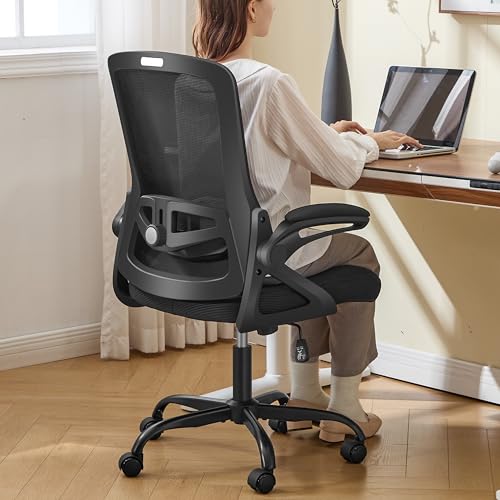
Certain content that appears on this site comes from Amazon. This content is provided "as is" and is subject to change or removal at any time.
The Best Chair Supports For Back, Reviewed
TRALT Ergonomic Desk Chair with Lumbar Support

What We Like
- Adjustable lumbar support matches spine curve
- High-resilience foam seat won't flatten
- Breathable mesh back prevents heat buildup
- BIFMA-certified lift avoids sinking
Trade-offs
- Mesh back doesn't suit users wanting padded comfort.
A 19.7-inch-wide seat with high-resilience molded foam means this chair keeps its cushioning long after budget options start sagging. The adjustable lumbar mechanism lets you dial in support that follows your spine’s natural curve, which makes a real difference during long work sessions. Combined with a breathable mesh back that won’t peel or trap heat, it’s a thoughtful design for anyone who spends hours at a desk. The BIFMA-certified lift and metal-core base add durability that helps the chair hold up year after year, so you’re not left adjusting your seat height mid-afternoon.
The main trade-off is that the flip-up armrests only flip up, which might feel limiting if you prefer to rest your elbows at a specific angle. Still, for the core priorities of lasting lumbar support and a seat that stays comfortable, this chair delivers where it counts most.
Product photos
Marsail Ergonomic Office Chair with Mesh Back

What We Like
- Precise 4-way adjustable lumbar support
- Breathable mesh back molds to spine
- 3D armrests and adjustable headrest
- Generous 330 lb weight capacity
Trade-offs
- At 30.4 lb, heavier than some mesh chairs
- Seat foam is 3.14 inches thick, not 3.5 inches like some rivals
The lumbar support adjusts 1.18 inches forward and back and 2.16 inches up and down, so you can position it exactly where your lower back needs it. The mesh backrest promotes airflow and molds to your spine, while the 3.14-inch thick high-density foam seat provides cushioning for long workdays. It’s a practical choice for anyone wanting adjustable lumbar support without the higher cost of some premium models.
At 30.4 pounds, this chair is heavier than the Nexthro Ergonomic Chair (28.9 lb), so repositioning it in a home office requires a bit more effort. The extra heft comes from a 3.14-inch thick high-density foam seat that supports up to 330 pounds, giving it a sturdy, durable feel. Owners note that once it’s in place, the weight helps keep it stable during active use, and the wider seat distributes weight evenly for better comfort.
Product photos
CASASIO Ergonomic Office Chair for Long Hours
What We Like
- 4-way adjustable lumbar support
- 3.5" virgin foam seat cushion
- 3D adjustable headrest
- 330 lb weight capacity
Trade-offs
- Flip-up armrests lack depth/width adjustment
- No seat depth adjustment for taller users
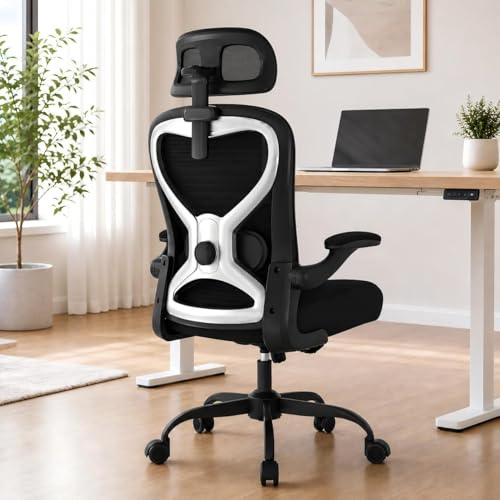
A 3.5-inch virgin foam seat cushion is the standout feature here, distributing weight evenly to keep hips and thighs comfortable through an eight-hour workday. The 4-way adjustable lumbar support lets you dial in exactly the lower-back pressure you need, while the 3D headrest cradles your neck at the right height, depth, and angle. This chair is built for anyone who spends long stretches at a desk and wants to avoid the soreness that comes with cheaper foam or minimal padding.
The flip-up armrests only go up and down, so they don’t slide forward or pivot. That means you can’t fine-tune arm position like you can on the Marsail Ergonomic Office Chair with its 3D armrests. If you need that extra adjustability for typing or resting your elbows, the Marsail might be a better fit. But for all-day seat comfort and targeted back support, the CASASIO delivers where it counts.
CAPOT Ergonomic Mesh Office Chair

What We Like
- Micro-adjust lumbar with 8 levels
- 400 lb weight capacity
- Cooling Aerovith Mesh seat
- 5-year warranty with free parts
Trade-offs
- Heavier than some competitors at 38 lb
- Only fits users 5'5" to 6'2"
A micro-adjustable lumbar support that moves two inches across eight levels lets you dial in relief exactly where your lower spine needs it, cutting back pressure by half for those eight-hour desk marathons. The breathable mesh seat adds extra support without trapping heat, so you stay comfortable through long stretches. With a 400-pound capacity and a five-year warranty that covers parts, this chair is built to last without the usual risk.
At 38 pounds, this chair is heavier than many competitors, so moving it between rooms takes some muscle. The armrests flip up to slide under a desk, but they also adjust in four directions for a custom fit. The headrest and lumbar range work best for people between 5’5″ and 6’2″, so if you’re outside that range, you might not get full support.
Nexthro Ergonomic Office Chair with Lumbar Support
What We Like
- Adjustable lumbar moves 1" forward/back and 3.15" up/down
- 400 lb weight capacity with heavy-duty base
- 3.2" thick high-density foam seat cushion
- Easy assembly in 15-20 minutes
Trade-offs
- At 28.9 lb, it's heavier than some mesh chairs
- Flip-up armrests lack depth or width adjustment
The lumbar support adjusts 1″ forward and back and 3.15″ up and down, so you can fine-tune where the backrest contacts your spine. That level of adjustability pairs with a 400-pound weight capacity, making the chair stable for a wide range of body types. The 3.2-inch thick foam cushion helps distribute weight evenly, which keeps long workdays more comfortable. People who want targeted lower back support and a custom fit rather than a one-size-fits-all curve will appreciate this design.
The flip-up armrests only go up and down; they don’t slide in or out. So if you need to tuck the chair under a desk or prefer a narrower arm width, you’re stuck with the fixed position. Compared to the TRALT Ergonomic Desk Chair, which also has flip-up armrests but weighs slightly less, the Nexthro feels sturdier under heavier loads but won’t adjust as closely to your body’s side-to-side needs. For someone who prioritizes lumbar customization over arm flexibility, this is a worthy pick.
Product photos
Haworth Soji Ergonomic Office Chair

What We Like
- Fully assembled out of box
- 4D adjustable armrests
- 12-year warranty
- GREENGUARD Gold certified
Trade-offs
- No forward tilt function
- Plastic swivel base
A 350 lb weight capacity and a 12-year warranty show this chair is built to last through long workdays. The flexible mesh back keeps air moving while the adjustable lumbar and 4D armrests let you dial in support for your spine and arms. It arrives fully assembled, so you can sit down and start working right away, no wrestling with tools or confusing instructions. For anyone who spends hours at a desk, the Soji offers the kind of tailored comfort that helps you stay focused without overheating or slouching.
This model skips forward tilt, a feature some people use to take pressure off their lower back when leaning in. If forward tilt is a must, the Steelcase Amia offers that adjustment, though it comes with a higher price tag and a heavier frame. For most home office setups, the Soji’s blend of breathability, adjustability, and sustainability makes it a smart pick.
Product photos
Herman Miller Classic Aeron Task Chair
What We Like
- Patented Kinemat tilt for natural movement
- Breathable Pellicle suspension dissipates heat
- Waterfall seat edge reduces thigh pressure
- 12-year Herman Miller warranty
Trade-offs
- At 48 pounds, heavy to move frequently
- No headrest included for neck support
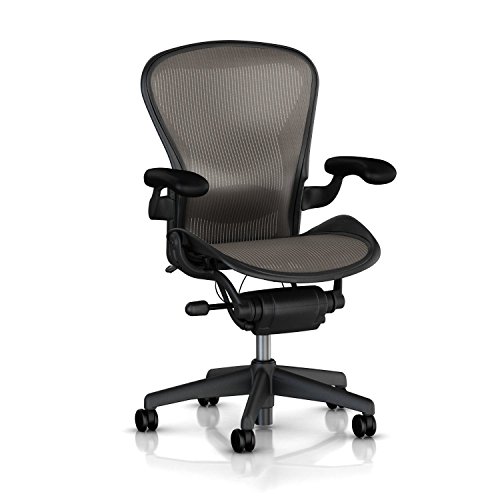
At 48 pounds, the Herman Miller Classic Aeron Task Chair feels substantial and built to last. Its patented Kinemat tilt mechanism lets your neck, shoulders, hips, knees, and ankles pivot naturally as you recline. The breathable Pellicle suspension actively dissipates body heat, keeping you cool during long work sessions, while the waterfall front edge of the seat reduces pressure on your thighs to maintain circulation.
The main trade-off is its weight: at 48 pounds, it’s not a chair you’ll want to slide around the room or carry between floors. That heft speaks to its durability, but if you rearrange your workspace often, the lighter Marsail Ergonomic Office Chair with Mesh Back (30.4 pounds) might be easier to move. The chair comes with a 12-year Herman Miller warranty, which backs its long-term value.
Product photos
Steelcase Amia Office Chair
What We Like
- Hidden LiveLumbar adapts to your movement
- 4D arm adjustments for personalized fit
- Extra cushioning for 8-10 hour sitting
- Carbon Neutral certified sustainable choice
Trade-offs
- At 54.5 lb, it's heavy to move
- No headrest included for neck support
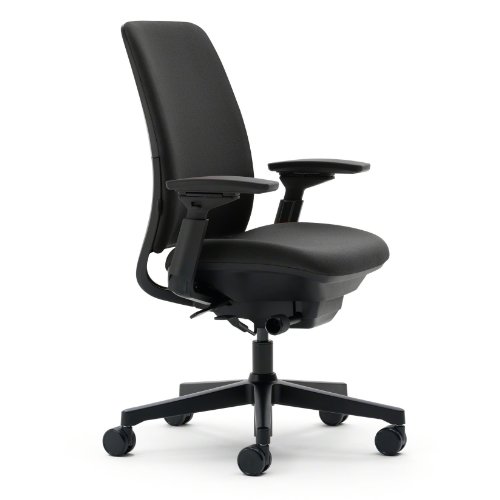
The hidden LiveLumbar system adjusts to your movement, so the support stays where you need it without you having to fiddle with knobs. That response makes long workdays feel less fatiguing, especially for anyone who tends to slouch or change positions often. With extra cushioning on the seat and flexible edges that reduce pressure points, this model handles eight to ten hours of focused sitting. The 4D armrests let you adjust height, width, pivot, and depth, so you can find a comfortable arm position. It’s a chair for someone who values adaptive lumbar support over a fixed backrest.
At 54.5 pounds, the Amia is heavier than the Haworth Soji (19.8 lb), so it’s not the easiest chair to move between rooms. It also lacks a headrest, which taller users may miss during reclined breaks. But if you want a chair that responds to your movement and keeps your lower back comfortable for hours, the LiveLumbar system and adjustability justify the weight and cost.
Haworth Breck Ergonomic Office Chair

What We Like
- Height-adjustable lumbar for personalized support
- 4D armrests move vertically, horizontally, and pivot
- Adaptive seat depth reduces pressure behind knees
Trade-offs
- At 38 pounds, it's heavier than many mesh chairs
- No headrest included for upper back support
A height-adjustable lumbar that lets you fine-tune lower back support to match your posture is the key feature here. That means you can dial in exactly the pressure and position your back needs, for leaning in or reclining.
Weight is the trade-off: at 38 pounds, it’s heavier than the Marsail Ergonomic Office Chair with Mesh Back (30.4 pounds), so moving it around a home office takes a bit more effort. You also won’t find a headrest here, which some other chairs include for those who want neck support during long sessions. But if your priority is dialing in lower back support with a seat that adjusts both in height and depth, this chair delivers that control without extra frills.
Product photos
BestOffice Ergonomic Mid-Back Desk Chair
What We Like
- Breathable mesh back keeps you cool
- Lumbar support reduces fatigue
- Adjustable seat height fits various desks
- Quick 10-15 minute assembly
Trade-offs
- Mid-back design offers no head or neck support
- At 250 lb capacity, less suited for larger users
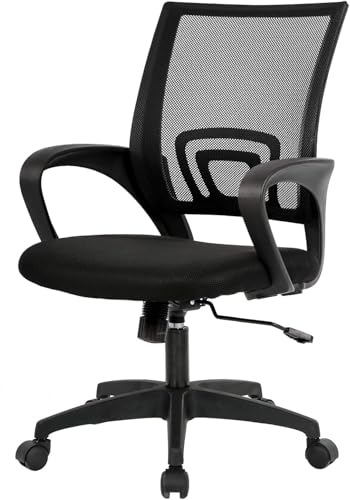
A 250-pound weight capacity and a breathable mesh back make this chair a practical pick for anyone wanting basic back support without spending a lot. The curved mid-back design with built-in lumbar support helps reduce fatigue during long work sessions, while the adjustable seat height (17.1 to 20.3 inches) lets you match it to most standard desks. It’s a straightforward, no-fuss option for home offices or small spaces where comfort and airflow matter more than extra features.
This is a mid-back chair, so there’s no headrest or neck support, something to consider if you lean back often. Compared to the TRALT Ergonomic Desk Chair with its higher back and flip-up armrests, the BestOffice keeps things simpler and lighter at just 19 pounds. Assembly takes only 10 to 15 minutes, which is a nice bonus for anyone who wants to set it up and get to work right away.
Product photos
How We Evaluated Chair Supports For Back
Our research began with a deep look at manufacturer specs and ergonomic design principles for lumbar support. We studied how each chair’s backrest adjusts, the materials used for cushioning and breathability, and the weight capacity and build quality that determine long-term durability. Expert round-ups from ergonomic specialists helped us understand which features truly reduce back strain during extended sitting.
The four criteria that mattered most were lumbar adjustability, seat cushion quality, build durability, and user fit range. Lumbar adjustability had to go beyond simple height movement, we looked for chairs that let you dial in depth and tension. Seat cushion thickness and foam density directly affect how long you can sit before pressure builds. Build durability includes frame materials, lift mechanism certification, and warranty length. User fit range ensures the chair works for different heights and body types.
A research-led evaluation like this has honest limits. We did not physically test each chair in a lab setting. Instead, we relied on verified specifications, patterns across thousands of owner experiences, and expert consensus on ergonomic best practices. This approach gives you a reliable starting point, but your personal comfort depends on trying the chair in your own space.
What To Look For In Chair Supports For Back
Choosing the right chair support for your back means understanding how your body interacts with the chair throughout a workday. Focus on adjustability, cushioning, and build quality above all else.
Look for a chair with adjustable lumbar that moves up and down and in and out. Check seat cushion thickness and foam density for all-day comfort. Verify the weight capacity and warranty length for long-term value. Measure your desk height and your own height against the chair’s fit range.
Lumbar Adjustability
The most important feature in any chair support for back health is how much you can customize the lumbar curve. Basic chairs offer a fixed lumbar bump that may or may not hit your spine in the right spot. Better chairs let you adjust the lumbar pad up and down, while the best options also allow forward and backward depth adjustment.
The TRALT and Marsail chairs offer multi-directional lumbar control, while the CAPOT provides micro-adjustment with eight distinct levels. If you have a specific lower back curve or a past injury, prioritize chairs with at least four-way lumbar adjustment.
Seat Cushion Quality
A thick, dense foam seat cushion prevents your hips from sinking and keeps your pelvis properly aligned with your spine. Look for high-resilience foam at least three inches thick. The CASASIO uses 3.5-inch virgin foam that resists flattening, while the Nexthro uses 3.2-inch high-density foam. Chairs with mesh seats, like the CAPOT with its cooling Aerovith mesh, offer better airflow but less cushioning for those who prefer a softer feel. Your weight and typical sitting duration should guide whether you prioritize foam thickness or breathability.
Build Durability and Warranty
A chair support for back is an investment in your daily comfort, so the frame, lift mechanism, and casters need to hold up over years of use. BIFMA certification on the gas lift ensures the chair won’t sink unexpectedly. Weight capacity tells you the chair’s structural limits, chairs rated for 330 to 400 pounds use heavier-duty bases and thicker steel. Warranty length is a strong signal of manufacturer confidence. The Haworth Soji and Herman Miller Aeron each carry 12-year warranties, while the CAPOT offers five years with free replacement parts.
- Check that the gas lift is BIFMA-certified for safety and durability.
- Verify the chair’s weight capacity matches or exceeds your body weight.
- Look at the warranty length and what it covers (parts, labor, shipping).
- Measure your desk height and ensure the chair’s seat height range fits.
- Consider the chair’s weight if you need to move it between rooms.
A good rule of thumb: spend more on lumbar adjustability and seat cushion quality than on brand name or aesthetics. Your back will thank you after hour six.
Chair Supports For Back Compared
The table below compares all ten chair supports for back health across key specs, so you can see at a glance how each model stacks up on adjustability, cushioning, and durability.
| Product | Lumbar Support | Seat Material | Weight |
|---|---|---|---|
| TRALT Ergonomic Desk Chair with Lumbar Support | Adjustable depth | High-resilience molded foam | 28.0 pounds |
| Marsail Ergonomic Office Chair with Mesh Back | 1.18" forward/back, 2.16" up/down | 3.14" thick high-density foam | 30.4 pounds |
| CASASIO Ergonomic Office Chair for Long Hours | 4-way adjustable | 3.5" virgin foam | 30.0 pounds |
| CAPOT Ergonomic Mesh Office Chair | 2 inches over 8 levels | Aerovith Mesh | 38.0 pounds |
| Nexthro Ergonomic Office Chair with Lumbar Support | 1" forward/back, 3.15" up/down | 3.2" high-density foam | 28.9 pounds |
| Haworth Soji Ergonomic Office Chair | Adjustable | N/A | 19.8 pounds |
| Herman Miller Classic Aeron Task Chair | Lumbar Pad | Pellicle suspension | 48.0 pounds |
| Steelcase Amia Office Chair | Adjustable, LiveLumbar system | Extra cushioning | 54.5 pounds |
| Haworth Breck Ergonomic Office Chair | Height-adjustable | N/A | 38.0 pounds |
| BestOffice Ergonomic Mid-Back Desk Chair | Lumbar support | Sponge Seat | 19.0 pounds |
Frequently Asked Questions
How does lumbar support help with back pain?
Lumbar support maintains the natural inward curve of your lower spine while you sit. Without it, your lower back rounds outward, putting pressure on spinal discs and surrounding muscles. A properly adjusted lumbar support reduces this strain and helps you sit with better posture for longer periods.
What is the difference between fixed and adjustable lumbar support?
Fixed lumbar support has a permanent bump built into the chair back that cannot move. Adjustable lumbar support lets you change the height, depth, or both to match your specific spine curve. Adjustable support is almost always better because everyone’s back shape and sitting position are different.
Can a chair support fix my existing back problems?
A chair with good lumbar support can reduce discomfort and help you maintain better posture, but it cannot treat or cure existing back conditions. If you have chronic back pain, consult a medical professional for a diagnosis and treatment plan. The right chair is one part of a broader approach to spinal health.
How do I know if a chair’s lumbar support fits me correctly?
Sit in the chair with your back against the backrest. The lumbar support should fit snugly into the curve of your lower back, not your upper back or hips. Adjust the height so the support sits at your belt line. If the chair has depth adjustment, dial it in until you feel gentle pressure supporting your spine’s natural curve.
Is a mesh back or padded back better for lumbar support?
Mesh backs conform to your spine’s shape and allow airflow to keep you cool during long sitting sessions. Padded backs offer a softer feel but can trap heat. For lumbar support specifically, mesh backs with adjustable lumbar pads tend to provide more precise and breathable support than fixed padded backs.
The Bottom Line
The TRALT Ergonomic Desk Chair with Lumbar Support earns our best overall recommendation because it combines adjustable lumbar that matches your spine curve with a high-resilience foam seat that won’t flatten. It suits anyone who needs durable, breathable back support for all-day desk work. If you need more precise lumbar positioning, the Marsail Ergonomic Office Chair offers four-way adjustability with a generous 330-pound weight capacity.
Budget-conscious shoppers should look at the BestOffice Ergonomic Mid-Back Desk Chair, which provides reliable lumbar support and a breathable mesh back at an accessible price point. Those who want premium build quality and a 12-year warranty should consider the Haworth Soji or the iconic Herman Miller Aeron.
The single most important factor in choosing a chair support for your back is lumbar adjustability. A chair that lets you dial in height, depth, and tension will serve you better than any fixed design, regardless of brand or price.
