10 Best Ro Filter Under Sink in 2026
This post contains affiliate links. As an Amazon Associate, we earn from qualifying purchases.
For clean, great-tasting water straight from your tap, the iSpring RCC7AK-UV 7-Stage RO System is our best overall pick, combining whole-system NSF certification with built-in UV sterilization and a mineral boost for balanced pH. If your under-sink space is tight, the Waterdrop G3P600 Tankless RO System offers a smart, space-saving design. For a straightforward, DIY-friendly option, the APEC Water ROES-50 delivers proven 5-stage filtration.
The challenge with under-sink RO filters is balancing filtration quality with the physical space they occupy under your sink. You need a system that fits your cabinet, matches your water usage, and addresses your specific water quality concerns without turning your storage area into a plumbing project.
We evaluated these 10 systems based on certified filtration stages, flow rates, tank vs. Tankless designs, and real-world owner feedback patterns to help you find the right fit for your home and water needs.
Top 10 Under Sink RO Filters in the Market
Certain content that appears on this site comes from Amazon. This content is provided "as is" and is subject to change or removal at any time.
The Best Under Sink RO Filters, Reviewed
iSpring RCC7AK-UV 7-Stage RO System

What We Like
- Whole system NSF 58 & 372 certified
- Built-in LED UV with smart flow activation
- Mineral boost for balanced pH
- Patented top-mounted faucet design
Trade-offs
- At 28.7 lb, heavier than many under-sink models
- Tank-based system takes up more cabinet space
A whole-system NSF 58 & 372 certification means every stage, not just individual parts, has been tested for contaminant reduction, giving you peace of mind that the water coming out is genuinely cleaner. The 7-stage design includes a LED UV stage for extra microbial protection and a mineral boost that adds back beneficial minerals for a balanced pH. The transparent first-stage housing makes it easy to monitor contaminant buildup, ensuring timely filter changes.
The trade-off is size and weight. At 28.7 pounds and with a tank, it takes up more under-sink real estate than a tankless model like the Waterdrop G3P600, which is lighter and slimmer.
Waterdrop G3P600 Tankless RO System

What We Like
- Tankless design saves 70% under-sink space
- Smart faucet with TDS and filter life display
- 2:1 low drain ratio saves water
Trade-offs
- Requires under-sink electricity for operation
- At 32 lb, heavier than some tankless alternatives
- Larger cabinet needed for 18-inch depth
A 600-gallon-per-day capacity means this tankless system keeps up with a busy kitchen, filling an 8-ounce cup in just 8 seconds. Its compact footprint frees up 70 percent of the space under your sink compared to traditional tank-style units, and the smart faucet shows you both TDS levels and filter life at a glance. This is a great fit for anyone who wants a high-output RO system without sacrificing cabinet storage, and the 2:1 pure-to-drain ratio means less wasted water than many competitors.
The G3P600 needs an electrical outlet under the sink, so if your cabinet lacks power, you will need to factor in an installation. At 32 pounds it is also heavier than the Philips AUT9360 (22 lb), which could make mounting a bit more involved.
APEC Water ROES-50 5-Stage RO System
What We Like
- 5-stage filtration removes 1000+ impurities
- NSF/ANSI 58 certified for performance
- DIY-friendly quick-connect fittings
- Includes brushed nickel faucet and tank
Trade-offs
- 50 GPD output slower than tankless models
- Storage tank takes up under-sink space
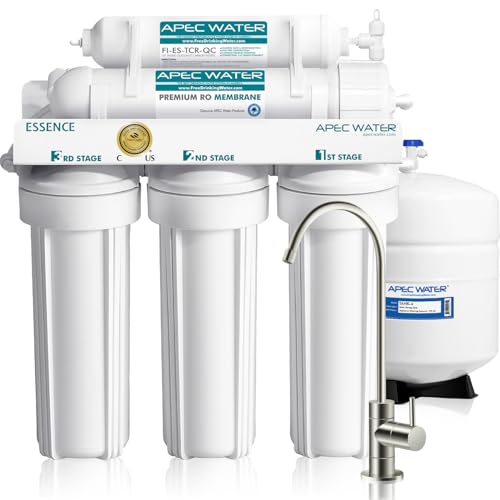
With a 50-gallon-per-day output and five stages of filtration, this system strips away up to 99.99% of impurities, including chlorine, lead, fluoride, and even PFAS and microplastics. That means water from your kitchen tap tastes clean and fresh, without the worry of hidden contaminants. The NSF/ANSI 58 certification backs up its performance, giving you confidence that every glass is as pure as promised. For someone who wants a straightforward, reliable RO system that doesn’t require a plumber to install, the included quick-connect fittings and color-coded tubing make setup surprisingly simple. The brushed nickel faucet and storage tank are all in the box, so there’s nothing else to buy.
The APEC Water ROES-50 produces 50 gallons per day, which means it fills its storage tank gradually. If you need to fill a large pot or water pitcher back-to-back, you might have to wait for the tank to recharge. For moderate daily use, drinking, coffee, cooking, the 5-stage filtration and easy maintenance make it a straightforward, reliable choice.
Waterdrop G3P800 10-Stage RO System
What We Like
- 800 GPD high capacity
- 10-stage filtration reduces PFAS and heavy metals
- Smart LED faucet shows TDS level
- Tankless design saves under-sink space
Trade-offs
- 33.7 pounds is heavier than many competitors
- Requires electricity for tankless operation
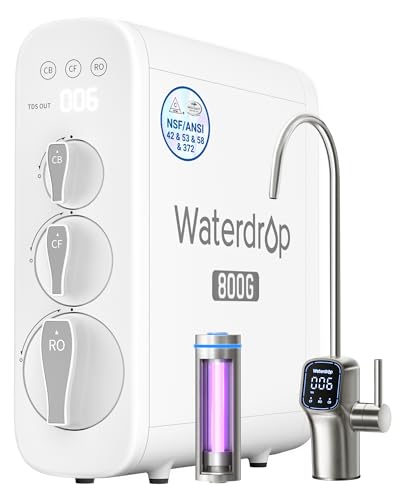
With an 800 GPD capacity, this system fills a cup in about five seconds, so a large household never waits for water. The 10-stage filtration reduces PFAS, lead, and many other contaminants, and the 3:1 pure-to-drain ratio means you get three cups of clean water for every cup of wastewater. The smart faucet shows TDS levels at a glance, so you always know your water quality without guessing.
The main trade-off is weight: at 33.7 pounds, this unit is heavier than many alternatives like the iSpring RO500AK (21 pounds), so installation may require a sturdy cabinet floor or extra support. However, if your priority is maximum output and thorough filtration without waiting for a tank to refill, the Waterdrop G3P800 delivers where it counts.
iSpring RO500AK Alkaline RO System
What We Like
- 0.4 GPM fills 8 oz in ~10 seconds
- 2:1 low drain ratio saves water
- Alkaline filter adds minerals for taste
- Tankless design saves under-sink space
Trade-offs
- Requires electrical outlet near installation
- Filter replacements needed every 6-24 months
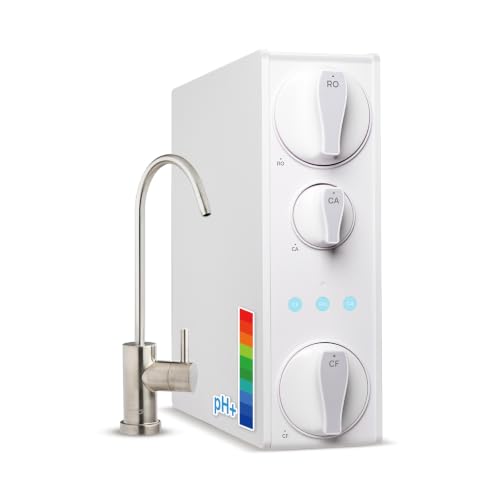
Filling an 8-ounce cup takes about 10 seconds, fast enough for everyday drinking and filling pitchers without waiting. This tankless system also uses a 2:1 pure-to-waste ratio, saving up to 400% water compared to traditional RO units. The built-in alkaline remineralization filter adds beneficial minerals back into the water, giving it a fresher, smoother taste that standard RO often lacks. It’s a great fit for households that want quick, great-tasting water without a bulky storage tank.
The iSpring RO500AK requires electricity, so you’ll need an accessible outlet under the sink before buying. If you have one, the tankless design frees up cabinet space and delivers up to 0.4 GPM, fast enough to fill an 8 oz cup in about 10 seconds. Without an outlet, this system won’t work, so check your setup first.
Home Master TMAFC-ERP Artesian RO System

What We Like
- Patented 2-pass remineralization adds calcium and magnesium
- 4.5-second fill rate for 8 oz glass
- 1:1 waste ratio with non-electric permeate pump
- Tool-free, once-a-year filter replacement
Trade-offs
- Larger footprint at 20 x 16 x 12 inches
- Storage tank requires under-sink space
A patented two-pass remineralization system adds calcium and magnesium back into the water twice during purification, so every glass delivers a crisp, mineral-rich taste that rivals bottled spring water. This approach ensures the water not only tastes great but also provides the natural minerals your body needs. Many under-sink systems only add minerals once, if at all, leaving the water flat. With this design, the water is enhanced at two separate stages, creating a more consistent and enjoyable flavor profile. Reviewers often note that the water from this system is noticeably smoother and more refreshing than standard reverse osmosis output, making it a favorite for daily drinking and cooking alike.
Its larger footprint means it takes up more cabinet space than some tankless models: 20 inches long, 16 inches wide, and 12 inches high, plus a separate storage tank. If cabinet space is limited, measuring the available area is advisable. For households that prioritize great-tasting, remineralized water and don’t mind the extra room, this system delivers on both performance and simplicity.
Product photos
Home Master TMHP-L HydroPerfection RO System

What We Like
- Patented 2-pass remineralization adds calcium and magnesium
- Includes Lux faucet and fridge connection kit
- EPA-registered UV sterilizer approved against viruses, bacteria, fungi
Trade-offs
- Requires under-sink space for storage tank
- Membrane limited to 75 GPD production rate
The patented 2-pass remineralization adds calcium and magnesium twice during purification, giving you great-tasting mineral water on tap while reducing storage tank degradation. It’s an excellent choice for anyone who prioritizes water safety and flavor, especially households concerned about biological contaminants.
This system uses a storage tank, so it needs more cabinet space than a tankless model like the Waterdrop G3P600. The 75 GPD membrane also means slower production than higher-capacity units. But if UV sterilization and dual remineralization are your top priorities, the comprehensive filtration and enhanced water quality make the extra cabinet space worthwhile.
Product photos
Express Water ROALK10D 10-Stage RO System

What We Like
- 10-stage filtration with alkaline remineralization
- Leak detection auto-shutoff for safety
- NSF 372 certified for lead-free materials
- Customizable with add-on filters
Trade-offs
- 100 GPD is slower than tankless models
- 27 lb tank system takes up cabinet space
The 10-stage system includes an alkaline filter that adds calcium, potassium, and magnesium to your water, along with reverse osmosis that removes up to 99.99% of lead, chlorine, fluoride, and other impurities. The 100 GPD output is steady enough for daily drinking and cooking, and the built-in leak detection gives peace of mind by automatically shutting off water if moisture is sensed. It’s a great fit for anyone wanting enhanced alkalinity and mineral content without sacrificing thorough contaminant reduction.
The tank-based design and 27-pound weight require more cabinet space than some tankless models. Installation uses quick-connect fittings, and the system is fully upgradable with UV or deionization attachments. For those who prioritize mineral enhancement and don’t mind the larger footprint, this is a well-rounded choice.
Product photos
GLACIER FRESH GFU03 Electric-Free RO System
What We Like
- No electricity required
- 3:1 pure-to-drain ratio
- 800 GPD fast flow
- 30-minute quick installation
Trade-offs
- Requires drilling 1/2"-1" hole in sink
- Minimum 40 PSI inlet pressure needed
- Filter must be flushed 10-20 minutes after replacement
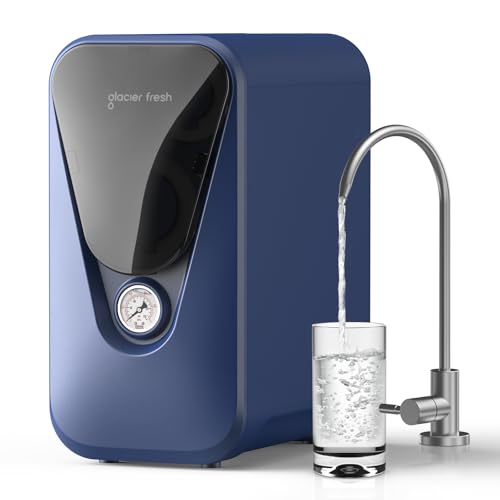
An 800 GPD flow rate means this system can keep up with a busy household, delivering purified water fast without waiting. Because it runs on water pressure alone, there’s no need for an electrical outlet under the sink, making it a smart pick for older kitchens or anyone who wants to skip the wiring hassle. The 3:1 pure-to-drain ratio also cuts down on wastewater, so you get more clean water per gallon used.
Owners should plan for a minimum 40 PSI incoming water pressure to keep the system flowing at its rated 800 GPD, and lower pressure will reduce output. Installation also requires drilling a ½- to 1-inch hole in the sink for the dedicated faucet, so checking clearance and access beforehand is wise. The trade-off is a 30-minute install time, half what traditional tank systems demand, and the tankless design frees up roughly 70% more under-sink space compared to bulky external storage units.
Product photos
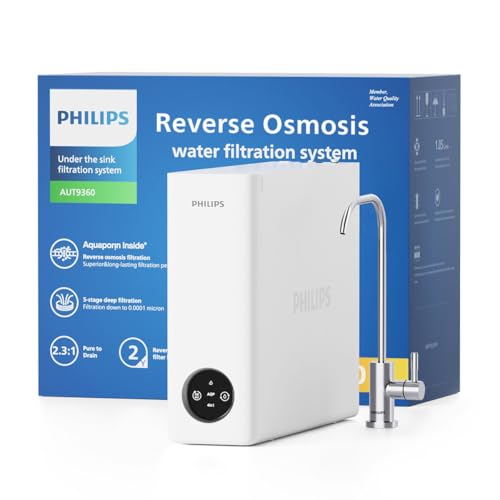
Philips AUT9360 Tankless RO System
What We Like
- 600 GPD tankless high-flow design
- Biomimetic Aquaporin RO membrane
- 2.3:1 pure-to-drain ratio
- Auto-cycle self-flushing maintenance
Trade-offs
- Requires under-sink power outlet
- Heavier than many tankless rivals at 22 pounds
A 600 GPD flow rate means this tankless system fills a small glass in about eight seconds, so you are never waiting for filtered water. The biomimetic Aquaporin membrane, inspired by natural water channels and tested with NASA and ESA, filters down to 0.0001 micron to reduce TDS, chlorine, and particulates. This makes it a smart pick for anyone who wants fast, space-saving filtration with cutting-edge technology under the sink.
Compared to the Waterdrop G3P600, which also offers tankless convenience and similar certifications, the Philips focuses on a higher pure-to-drain ratio (2.3:1 vs. 2:1) and a more compact footprint. If you have the electrical access and want a sleek, high-efficiency system with a science-backed membrane, this is a compelling option.
Product photos
How We Evaluated Under Sink RO Filters
Our evaluation is research-based, drawing from manufacturer specifications, NSF/ANSI certification data, expert round-ups, and patterns in owner feedback. We focused on what matters most when choosing an under-sink RO system: filtration effectiveness, physical footprint, flow rate, and long-term maintenance.
The first criterion was certified filtration. We prioritized systems with NSF/ANSI certifications, particularly NSF 58 for performance and NSF 372 for lead-free materials, as these provide verified assurance of what the system removes. We also looked at the number and type of filtration stages, from basic sediment and carbon filters to specialized UV, alkaline, and remineralization stages.
Second, we considered cabinet footprint and installation. Tank-based systems require space for a storage tank, while tankless designs free up room but often need an electrical outlet. We evaluated dimensions, weight, and whether the system included a dedicated faucet and easy-to-use fittings.
Third, we assessed flow rate and water efficiency. We compared gallons per day (GPD) ratings and pure-to-drain ratios to identify systems that deliver water quickly without wasting excess. Finally, we noted maintenance requirements, including filter replacement frequency and whether the system offered tool-free or once-a-year filter changes.
What To Look For In Under Sink RO Filters
Choosing the right under-sink RO system comes down to matching the filtration power with your kitchen’s physical and electrical setup.
Look for NSF-certified filtration for verified contaminant removal, choose between tank or tankless based on your cabinet space, and check the GPD flow rate to match your household’s water demand.
Certified Filtration Stages
The number of stages matters less than what each stage does and whether the system is certified. A standard 5-stage system includes sediment, carbon, RO membrane, and post-carbon filters. Higher-stage systems add UV sterilization, alkaline remineralization, or specialized media for PFAS and heavy metals. Look for NSF/ANSI 58 certification for the complete system, not just individual components, to ensure the whole unit performs as claimed.
Tank vs. Tankless Design
Tank-based systems store filtered water in a pressurized tank, typically taking up 10-15 inches of cabinet space. They work without electricity and provide a steady supply, but the tank can limit storage. Tankless systems filter water on demand and save significant under-sink space, but they require a nearby electrical outlet and are generally heavier. Measure your cabinet depth and check for an accessible power source before deciding.
Flow Rate and Water Efficiency
Flow rate is measured in gallons per day (GPD) or gallons per minute (GPM). A 50 GPD system fills a glass in about 30 seconds, while 600-800 GPD tankless models can fill it in under 10 seconds. Also consider the pure-to-drain ratio: a 2:1 ratio means you get two cups of filtered water for every one cup of wastewater. Higher ratios save water and reduce your environmental impact.
- Measure your under-sink cabinet height, width, and depth before shopping.
- Check if your sink has an existing hole for a dedicated faucet or if you need to drill one.
- Verify your incoming water pressure (minimum 40 PSI for most systems).
- Confirm whether a power outlet is available under your sink for tankless models.
- Look at filter replacement costs and intervals to estimate long-term expenses.
A system that fits your cabinet and your water pressure is more important than one with the most stages.
Under Sink RO Filters Compared
The table below compares all 10 under-sink RO filters side by side, highlighting their key specs and best-use scenarios.
| Product | Stages | Dimensions | Weight |
|---|---|---|---|
| iSpring RCC7AK-UV 7-Stage RO System | 7-Stage | 15 x 8 x 18 in | 28.7 lb |
| Waterdrop G3P600 Tankless RO System | 8-stage | 18.1 x 5.7 x 17.8 in | 32.0 pounds |
| APEC Water ROES-50 5-Stage RO System | 5-Stage | 15.5 x 5.2 x 17.0 in | 24.9 lbs |
| Waterdrop G3P800 10-Stage RO System | 10-stage | 18.1 x 5.7 x 17.7 inches | 33.7 pounds |
| iSpring RO500AK Alkaline RO System | N/A | 17.5 x 5.2 x 16.2 inches | 21.0 pounds |
| Home Master TMAFC-ERP Artesian RO System | 7-Stages | 20.0 x 16.0 x 12.0 inches | 14.5 pounds |
| Home Master TMHP-L HydroPerfection RO System | 9 | 15.0 x 5.0 x 16.0 inches | N/A |
| Express Water ROALK10D 10-Stage RO System | 10-Stage | 15 x 5 x 17 inches | 27.0 pounds |
| GLACIER FRESH GFU03 Electric-Free RO System | 7-Stage | 13.6 x 8.3 x 16.5 in | N/A |
| Philips AUT9360 Tankless RO System | N/A | 15.8 x 4.3 x 12.3 in | 22.0 lbs |
Frequently Asked Questions
What is the best under sink RO filter for a small kitchen?
The Waterdrop G3P600 Tankless RO System is the best choice for small kitchens because its tankless design saves about 70% of under-sink space compared to traditional tank-based systems. It also includes a smart faucet with TDS display and a 2:1 low drain ratio to save water.
Do under sink RO filters remove fluoride?
Yes, most reverse osmosis systems with a carbon pre-filter and RO membrane effectively reduce fluoride. The APEC Water ROES-50 and iSpring RCC7AK-UV both include stages designed to remove fluoride along with over 1,000 other contaminants.
How often do I need to replace the filters on an under sink RO system?
Filter replacement schedules vary by model and water usage. Most systems require sediment and carbon filter changes every 6-12 months, with the RO membrane lasting 2-3 years. The Home Master TMAFC-ERP Artesian RO System offers a once-a-year filter replacement for simplified maintenance.
Can I install an under sink RO filter myself?
Many under-sink RO systems are designed for DIY installation with quick-connect fittings and clear instructions. The APEC Water ROES-50 and GLACIER FRESH GFU03 are known for straightforward setups. However, some models may require drilling a hole in your sink or countertop for the dedicated faucet.
What is the difference between a tank and tankless under sink RO system?
Tank-based systems store filtered water in a pressurized tank, taking up more cabinet space but working without electricity. Tankless systems filter water on demand, saving under-sink space and providing faster flow, but they require a nearby electrical outlet. Tankless models are generally heavier and may cost more upfront.
The Bottom Line
The iSpring RCC7AK-UV 7-Stage RO System is our best overall pick for homeowners who want comprehensive, certified filtration with the added benefits of UV sterilization and mineral enhancement. It is ideal for those who have adequate under-sink space for a tank-based system and want peace of mind from whole-system NSF certification.
If your under-sink cabinet is tight or you prefer a modern, space-saving setup, the Waterdrop G3P600 Tankless RO System delivers fast flow and smart features. For a budget-friendly, DIY-friendly option that still provides excellent filtration, the APEC Water ROES-50 is a reliable choice.
The single most important factor in choosing an under-sink RO filter is matching the system’s physical footprint and power requirements to your specific kitchen setup. Measure your cabinet, check your water pressure, and confirm outlet availability before making a decision.
